 |
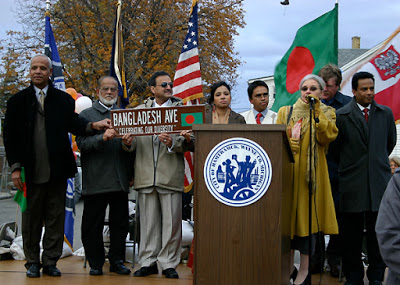
| The initial recognition by the city of Hamtramck for the contributions of the Bangladeshi community came in 2008 when Conant Avenue was co-named Bangladesh Ave. |
Hamtramck, once known as Poletown for its substantial Polish
immigrant population, has been transformed into BanglaTown, recognizing that the city is
now home to one of the nation’s densest Bangladeshi populations.
Gov. Rick Snyder joined in a celebration this morning of
the latest addition to the BanglaTown neighborhood that straddles Hamtramck and
Detroit – the opening of a Bangladeshi American Public Affairs Committee (BAPAC)
office on Conant Avenue.
saluted the scores of Bangladeshi-owned businesses that have opened on Conant, the main
street of BanglaTown, over the past decade. Thousands of residents, natives of
Bangladesh, have also helped to revitalize the neighborhood.
“BanglaTown is a largely untold story of how immigrants
can work with local residents to
revitalize urban neighborhoods in Detroit and Hamtramck,”
said Steve Tobocman, executive
director of Global Detroit, which has been working with BAPAC
on economic development and neighborhood initiatives.
as it is home to large numbers of Polish, Yemeni, Bosnian and African-American
residents, as well as Bangladeshis. In the area along Conant, the
neighborhood’s budding, flamboyant artist community is also growing.
In fact, BanglaTown voting precincts offer the only U.S. election ballot
in the Bengali language, the so-called “Bangla ballot.” Today’s event was commemorated
with the unveiling of an elaborate rickshaw imported from Bangladesh that had
been painted to highlight the themes of Bangladeshi cinema and culture.
5,000 residents are identified as Asian (mostly Bangladeshi), 30 percent as
African-American, and nearly 10 percent as two or more races.
Nearly two-thirds of the residents of this neighborhood
live at or below the poverty level and 40 percent are under the age of 18. More
than half of the households speak a language other than English at home and nearly
40 percent speak English less than well.
Yet, Conant Avenue is bustling with activity and stands
as one of the few neighborhood retail strips in Detroit with virtually no
vacancies, according to Global Detroit. In an area that was decimated in recent
years by home foreclosures and blight, revitalization is rampant and neighborhood relations remain relatively
free of the conflict that often characterizes communities with an influx of
immigrants and a mix of such different cultures.
for the community and will help connect business and residents with “resources and opportunities.”
The office staff will work to attract more customers and visitors to the
businesses and cultural offerings of BanglaTown.
BAPAC, Global Detroit and other community organizations will help
bridge language and cultural barriers.
found the time to help celebrate our community and the contributions that the Bangladeshi
community has made to Michigan,” said Ehsan Taqbeem, a local entrepreneur and co-founder
of BAPAC. “Bangladeshi residents have found a welcoming home in Metro Detroit
and across Michigan and we know that our community can play a central role in the region’s
rebirth.”