Once again the national firm of Public Policy Polling has
demonstrated that those who respond to campaign surveys are, to some extent,
winging it.
Or maybe a few of them are playing the game of Messin’
With The Pollster.
farm boy from Iowa, but you may have heard of Deez Nuts, the name Olson used
when he officially filed to run for president.
Olson took advantage of a federal paperwork system that
does very little vetting when someone files as a presidential candidate. Then
he convinced PPP, on a lark, to include his name in their polling.

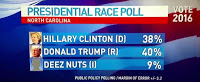
The result? Nearly one in 10 North Carolina voters said they’d
vote for the independent candidate, Deez Nuts, in a three-way 2016 general
election race with Hillary Clinton and Donald Trump.
Brady Olson’s little scam has made him an overnight, worldwide sensation on
Twitter.
In the North Carolina poll, 6 percent of voters said they
have a favorable opinion of Deez Nuts. Another 13 percent said they have an
unfavorable view of the phony candidate. And 81 percent of the respondents were
honest enough to say “not sure.”
I’m not sure what to make of the demographic breakdown,
as the 18-29 age bracket gave this assessment of Deez Nuts: 15 percent
favorable, 36 percent unfavorable, and 49 percent unsure.
respondents lie to pollsters, often out of fear of sounding uninformed.
running joke, including one time when Michigan Gov. Rick Snyder was the butt of
the joke.
In May, when Snyder was still toying with the idea of
running for president, PPP pollster Tom Jensen told a Detroit Free Press
journalist that he, political reporter Paul Egan, could poll as high as Snyder
on favorability in a state where the governor was an unknown.
Jensen decided to test his theory and was proven correct when Arizona voters
participating in a PPP poll gave Snyder a 5/11 percent favorable-unfavorable
rating. Egan stood at a 6/7 percent favorable-unfavorable status. The rest of
the respondents admitted that they knew nothing about the two men.
polling specialist at PPC, first put the name in a Minnesota poll a few weeks
ago and Nuts received 7 percent of the vote against Clinton and Trump. In Iowa,
he grabbed 8 percent support. And in N.C. this week he was up to 9 percent.
Of course, it should be pointed out that we’re dealing
with a kid with a silly-sounding fake name, borrowed from a crude online meme that was popular several years ago, who fails to meet the threshold to legally vote (18
years old) or to run for president (35 years old).
numbers show a certain amount of disenchantment with the parties’ two
frontrunners, Clinton and Trump, and that “clearly, there’s some kind of floor
here for third-party entities that’s rising.”
“I think having Trump as part of the poll helps push that
number up because it leaves room for the non-hardcore Republicans who are not
going to get on board with Donald Trump,” Williams added.
all of this if they understood that there’s also a logistical reason Nuts is
polling so well.
“The polls are pretty long. By the time we drop Deez Nuts
on them, they’re pretty deep into the poll,” Williams said in the interview.
Then he paused.
“The jokes write themselves.”