

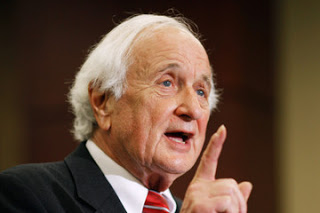

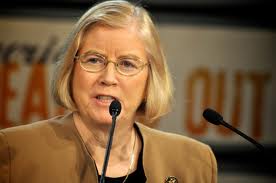
The $46 billion business tax cut that passed the House on Thursday produced about as wide of a partisan gap as we ever see between Macomb County’s two representatives, Candy Miller and Sandy Levin.
The bill, which has little chance of passage in the Senate, would give small businesses with fewer than 500 employees a 20 percent tax cut. Supporters of the legislation say that cash-strapped small businesses currently face federal tax rates as high as 35 percent and the bill would create jobs. Opponents say the bill is a giveaway to wealthy business owners and there is no evidence that it is a job-creating engine.
Estimates indicate that the tax cut would help 22 million companies. In Michigan, 173,000 small businesses that employ 1.7 million workers would benefit. But about half of the recipients currently earn more than $1 million a year.
Here are the two lawmakers’ statements on the bill, which passed by a healthy margin:
Miller, a Harrison Township Republican, said:
“We all understand that getting our economy moving and putting in place an environment that incentivizes new job creation should be and must be our top priority. We also understand that American small businesses are the engine of job creation. I have spoken with many small business job creators in my district who all share the same message — government over-regulation and over-taxation is stifling their ability to grow. This House has already acted decisively to address government over-regulation and we (now) act decisively to give small businesses tax relief they need to grow.
“Allowing small businesses with less than 500 employees a 20 percent tax cut will free-up capital and allow those businesses to invest in and grow their businesses and create jobs we so desperately need in this economy. I was disappointed to see President Obama threaten a veto of this bill that could help so many small businesses. And I was even more disappointed when the White House called it a salve to high priced lawyers, consultants and other wealthy individuals with the biggest profits. I would remind the president that General Electric, whose CEO is the chairman of his jobs council, made a profit of $14.5 billion in 2010 yet paid no federal income taxes. Giant profitable companies like General Electric would not benefit from this tax cut, but countless American small business job creators that are paying taxes will get relief.
“I believe that the hundreds of small manufacturing firms and other small businesses in Michigan that are struggling to buy new equipment, to pursue new customers and to grow their business are not among the corporations with the biggest profits, and they would benefit from this bill. I trust American small businesses to spend their money more wisely than government ever will and was proud to have been a cosponsor of this legislation.”
Levin, a Royal Oak Democrat who represents most of Macomb County, said:
“This bill needs to be graded and the grade it gets is an ‘F.’ A fat ‘F’ grade. It fails all tests of sound tax policy.
“Let me start with truth in advertising. This is not a small business bill. It’s small business in name only. It’s totally untargeted. It applies as long as an entity has under 500 employees — those benefiting include law firms, sports teams, financial consultants, lobbyists, corporate farmers. And (they benefit) regardless of what their annual receipts are — they can be tens of millions or hundreds of millions of dollars. Interestingly, when the SBA (Small Business Administration) looks at its loan program it has what’s called a common standard — the businesses it serves cannot have more than $7 million in annual income — average annual receipts for most non-manufacturing firms. This bill has no limits – none — as to function or amount of receipts. So really this bill mocks the use of the title ‘small business.’
“This isn’t about mom and pop. It’s about popping the cork for wealthy taxpayers.
“… This is the Bush tax cuts on steroids.
“In terms of job creation, another ‘F’ grade. Listen to the Joint Tax Committee analysis. It says this bill’s economic impact, I quote, ‘is so small as to be incalculable.’”






Thank You!!! Candice Miller. I'm sorry to say this, Mr. Sander Levin "F" really stands for Fraud, Fiction and Non-Factual…….Unfortunately the Levin’s can't be trusted! For Example: Sander’s newsletter (3/29/2012), Titled: Affordable Care Act Improving Health Care in Michigan 2011 Report Card. The first sentence tells it all “In the two years since the Affordable Care Act (Obamacare) was signed into law, it has benefited Millions of Michiganders by improving health care coverage and reducing cost. Anybody whose pays for Health Insurance & Health Care knows this is outrageous statement!
Letter to Dave Camp & Fred Upton 5/5/2011 (Third paragraph) Sander Levin claims that the Affordable Care Act, His words “Medicare drug coverage that CLOSED the Medicare Part D donut hole. Fact: 2012 Donut Hole $4,700 set by CMS.
These tactics & misleading information would make Lee Atwater Blush!
Thank You for your 30 years of service, at 81 you’ve earned your retirement gold watch.