 |
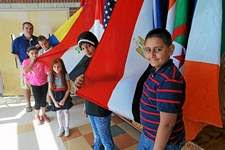
| Students in Sterling Heights display their national flags of origin. |
As a richly traditional blue-collar, ethnic community
featuring a melting pot of American successes among its businesses and workers,
Macomb County now endures a bitter irony in that its second- and
third-generation immigrants crassly single out new arrivals from other nations
as suspicious interlopers.
The divide over immigration bloomed this week as County
Executive Mark Hackel promoted “Welcoming Week” for Macomb’s new generation of
immigrants. Yet, in Sterling Heights, the County’s second-largest city (and the fourth-largest in Michigan) many continue to rage against Muslim
residents and potential refugee arrivals.
candidates that critics consider bigoted – if not blatantly racist and
homophobic – running to oust all the incumbents for mayor and council. The political
tensions rose several notches in recent weeks over a proposed mosque near 15
Mile Road that generated xenophobic opposition.
In addition, one of the most outspoken members of the
opposition slate, council candidate Jazmine Early, calls for provisions that
would allow Sterling Heights to block refugees seeking asylum from war-torn
Syria.
Welcoming Week, running from Sept. 12-20, with several events celebrating
Macomb’s multiculturalism and diversity. The county executive jumped to the
forefront of Gov. Rick Snyder’s pro-immigrant policies a couple of years ago, recognizing
the economic vitality generated by arriving immigrants and making Macomb the
first “welcoming county” in Michigan.
This week, Hackel hosted a day-long program at Macomb
Community College on Wednesday where officials from welcoming cities and
counties planned for increased immigration and assimilation to their
communities.
On Friday, Hackel will preside over a naturalization ceremony at
MCC, organized by OneMacomb, a group that promotes inclusiveness, where dozens
of immigrants will take their take their oaths of citizenship.
diverse population by participating in initiatives such as Welcoming America,”
said Hackel. “We want all of our residents to know that we appreciate their
making Macomb County their home.”
Sterling Heights recently in opposition to the proposed Muslim site of worship. At city
council meetings, local Muslims who spoke out in favor of constructing the
mosque were jeered. Those opposed were cheered.
This comes from a city that was widely mocked in recent decades as “Sterling
Whites,” in reference to its lack of diversity.
The ugliest aspect of this story is that some of the most
outspoken critics of an Arab place of worship in a residential area are Chaldeans
– Iraqi Christians who compromise 12 percent of the city’s population, and some
of whom were brought here as refugees fleeing the Iraq War.
At a recent council meeting, Saad Antoun said the mosque
would be better suited in “either Dearborn, or somewhere else, just not
that (15 Mile) area.”
Antoun held up a photo of a woman wearing a niqab, an
Islamic face-covering worn by some Sunni Muslims.
“This mosque is going to bring … people like
this,” Antoun said, displaying the image to the council and crowd. “I
don’t want to be near people like this. This is not humanity … This is scary.
And disgusting. This cannot stand. Please stop the mosque.”
Other residents voiced similar concerns, without offering
any evidence of current community troubles. Some tried linking the proposed
mosque to Islamic extremists in the Middle East such as the ISIS terrorist
group.
officials suddenly reversed themselves and said that the proposed mosque did
not fit with the adjacent residential subdivision setting. The city Planning
Commission unanimously rejected the special land-use plan, though numerous
Christian churches in the city lie next to residential areas.
What’s more, an 11,500-square-foot center, the Chaldean
Community Foundation, is opening this fall on 15 Mile close to where the
proposed mosque would have been located.
City officials now say a better location can be found for
the place of worship proposed by the Madison Heights-based American Islamic
Community Center.
from an inconsequential, vanilla farm community north of Detroit to a major
suburban county, now approaching 900,000 residents, fueled by an influx of ethnic
Polish, Italian and German homeowners over several decades. Many of those newcomers spoke little or no English but they established a work ethic that remains true to this day.
inflow to Macomb has included Iraqis, Albanians, Serbs, Hmong, Indians and an array of Far
East Asians.
future of the county remains inextricably tied to the outcome of the November
Sterling Heights elections.
Collectively, among K-12 students across Macomb, more
than 100 different languages are spoken at home. Many of those kids’ parents
have demonstrated an entrepreneurial spirit that exceeds those of county
residents with generations of true-blue American ties.
Macomb County residents can stay true to their heritage and speak with one
voice.