The New Hampshire secretary of state’s outlandish statement yesterday that the state may hold its first-in-the-nation presidential primary on Dec. 6 prompts a question with perhaps an even more outlandish answer: What would that mean for the Iowa caucuses?
If New Hampshire actually made such a reckless move, election rules in Iowa say that their presidential caucuses must be held eight days before any other primaries or caucuses.
That would put the Hawkeye State vote at Tuesday, Nov. 29, just after Thanksgiving.
Many political pros assume that cooler heads will prevail, that longtime New Hampshire Secretary of State William Gardner is only reacting with a bit of anger to all the jockeying by other states seeking a prime spot on the primary calendar.
But so far, cool heads have been hard to come by and top party officials have failed to talk sense to state party people, especially in Florida, which set off this chain reaction.
At The Atlantic, Molly Ball reports that Gardner said he refuses to shove the New Hampshire vote between a Jan. 3 Iowa caucus and a Jan. 14 Nevada caucus, as would be likely under the current scenario. As a result, he said he cannot rule out a December primary in the Granite State, one that would avoid the Christmas season and therefore could be held on Dec. 6 or 13.
The primary calendar chaos began when a Florida panel decided to hold that state’s primary on Jan. 31, scratching the Democratic and Republican parties’ plans to delay the beginning of the nominating process until February.
South Carolina has scheduled its primary for Jan. 21. That prompted Nevada’s Republican Party to claim Jan. 14, a Saturday, and Iowa Republicans to reluctantly, tentatively embrace Jan. 3 for their vote.
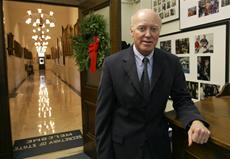
New Hampshire Attorney General William Gardner/AP photo
New Hampshire law requires that Gardner set the first-in-the-nation primary seven days before any other primary contest, save Iowa’s.
The decision is Gardner’s alone, a role that he relishes. He assures that New Hampshire could quickly set up the necessary logistics to hold an election in about seven weeks, on Dec. 6. Since taking office in 1976, Gardner has waited until later than mid-October in the past to set the election date.
But the logistics are much tougher to deal with in Iowa, which holds caucus meetings that require far more preparation and organization. Officials there say they must set a date soon, before the end of this month.
Jennifer Jacobs of the Des Moines Register reports that, although Iowa law mandates that the caucuses be held eight days before any other caucuses or primary, that’s generally been viewed as a guide. The Iowa and New Hampshire votes were only five days apart in 2008.
A member of the Iowa GOP’s state central committee even suggested that, under the circumstances, Iowa may abandon its traditional role as part of a one-two punch with New Hampshire to start the nominating process.
“I would prefer us to be the first caucus state in January, rather than to be first in the process, meaning caucus and/or primary, in December,” Ivers said. “But New Hampshire has not made a decision, and Iowa has not made a decision.”