By CHAD SELWESKI
Chad.selweski@macombdaily.com; @cbsnewsman
Tuesday, May 21,2013

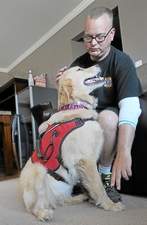
Dave Denhardt with his assistance dog Tank. (The Macomb Daily/DAVID DALTON)
Dave Denhardt, a former Marine, made a life-changing decision at age 38 to rejoin the military.
The
Army National Guard welcomed him with open arms, made him an
infantryman and sent him to one of the combat-plagued forward areas in
Afghanistan.
Within a year, in April 2012, Denhardt’s base was hit
by a rocket attack and he suffered severe head injuries that led to
seizures, headaches and dizziness. Thankful to be alive within the “kill
zone” of the explosions, Denhardt didn’t immediately realize how many
health problems — and bureaucratic problems — he would soon face.
He
had been thrust into another war. This time, he would be battling the
military red-tape within the bureaucracy of the Army and the Veteran’s
Administration.
That’s a war with more than one million casualties.
Medical
personnel determined that Denhardt’s condition was permanent and he
would need the assistance of a service dog. But then he was told that
acquiring a special-needs dog from a nonprofit group associated with the
VA would take four to six years. With the help of the VFW and a
Muskegon Key Club, the Shelby Township resident in March was able to
purchase a service dog from a for-profit agency in Fenton.
That was only the first hurdle cleared by a man who will likely never walk again without assistance.
Denhardt
was not discharged, he was sent by the Army to a special unit for the
wounded, the Warrior Transition Battalion at Ft. Knox in Kentucky, where
he lives in the barracks.
But dogs are not allowed in the
barracks. So Denhardt, who relies upon a wheelchair, travels back to his
Macomb County home every weekend to become acclimated to his service
dog.
“I’m being trained to work with the dog. It’s a bonding
issue,” said Denhardt, a member of the Delta Company 237th Support unit
based at the Detroit Light Guard Armory.
But the process of
winning approval for the service dog has involved numerous approvals at
several levels within the Army and VA.
‘I push and I push’
“They’ve
got all kinds of excuses on why they don’t want me to have the dog.
They say, ‘If you get one, then everybody will want one,’ ” he
explained.
Denhardt, now 40, is understandably frustrated because
the reasons he needs a service dog are many: injuries to his head, neck
and left arm; Post Traumatic Stress Disorder; a Traumatic Brain Injury; memory loss;
frequent dizziness and lack of balance due to a destroyed ear drum;
little use of his left hand due to numbness throughout his left arm; and
the surgical removal of a portion of his left collar bone.
The
dog, a golden retriever called Tank — a name chosen by Denhardt’s
5-year-old daughter — is trained in assisting people like Denhardt who
suffer from PTSD, seizures and nightmares.
Yet, Denhardt is again improvising, seeking his own solutions due to a lack of VA and military assistance.
Denhardt’s
wife is taking a 6-month leave from her job as a nurse so she can help
her husband find off-base housing near Ft. Knox and assist him with the
transition to a life dependent on Tank on a 24/7 basis.
“Of
course, I felt frustration and anger when things were spinning out of
control. But I’m a very positive person and I push and I push and I
push, trying to make the system work so I get things done,” he said.
In
the meantime, Denhardt is pursuing a full-fledged retirement from the
military for medical reasons. The average wait for approval: 405 days.
Waiting has become standard military procedure for our nation’s sick and disabled veterans.
The highly publicized backlog of veterans seeking VA benefits presents an average wait of 410 days in the Detroit area.
Yet,
Macomb County veterans are fortunate. Macomb is one of the few counties
in Michigan that levy a separate property tax, a millage, to help fund
its Department of Veterans Affairs.
In 2012, Macomb became one of
the first of Michigan’s 83 counties to create a Veterans Court for those
facing non-violent criminal charges.
“Macomb did an excellent job
in getting the millage passed. (MCVA Director Kermit Harris) and his
department — they’re one of the best. So, you guys in Macomb are lucky,”
said retired Brig.
Gen. Carol Ann Fausone, who served 8½ years in
the No. 2 military post in the Michigan National Guard, as the
assistant adjutant general for the Department of Military and Veterans
Affairs.
The county department acts as an advocate and a liaison
between the veteran and the VA. The staff also helps vets with obtaining
certified copies of military discharge papers, and service medals and
ribbons.
The millage allowed the department to whittle down a 5-week waiting list to one or two weeks.
The
number of service officers/counselors rose from two to five. In 2012,
the department provided service to 7,511 vets, a 7.2 percent increase
from 2011.
Voters back vets
Macomb County voters first approved
the small property tax for veterans services in 2008, reducing a
five-week wait to see a service officer or counselor down to one or two
weeks. The tax costs the average homeowner $3 to $5 per year but it
generates about $1.3 million annually for the department.
When the
millage came up for renewal in 2012, veterans groups expressed worries
due to an anti-tax furor created by a new millage proposed to fund the
Detroit Institute of Arts museum.
Doug Mills, senior vice
commander of the Macomb County Council of Veterans Organizations, a
coalition of about 50 veterans units, helped organize a successful
millage renewal campaign.
“It’s like a brick wall between the vets
and that (needed) care,” Mills said at the time. “What these (county)
service officers do is help vets get over that wall. They know how to
fight, how to do the paperwork and file appeals.”
The department
also developed an innovative way to alert local veterans about the
services offered in Macomb County. They produced a 30-second public
service announcement that will be shown repeatedly at local MJR theaters
over the next several weeks.
The video, featuring department
staff, will be shown several thousand times during the pre-preview
portion of movie-going sessions at a cost of $20,000.
At the
Macomb County Veterans Treatment Court, about half of those accepted to
appear before the court suffer from PTSD, which often triggers substance
abuse. Many others say their addiction started when they abused their
war-related pain medication.
Participants go through intense
probation in which they initially appear in front of a circuit court
judge once a week and attend counseling sessions and Alcoholics or
Narcotics Anonymous meetings multiple times per week. Court appearances
gradually decrease to once per month as they progress through the
program.
The special court represents just one example of the
constant struggle by counselors and service officers associated with the
county and veterans groups to educate veterans about the many programs
available to them, even if they were not wounded on the battlefield or
were discharged decades ago.
Benefits go unclaimed
Perhaps the
greatest problem facing officials is the under-the-radar approach taken
by veterans of the 1991 Gulf War and the wars in Iraq and Afghanistan.
Many younger former soldiers shun veterans groups such as the VFW or
American Legion. Others seek to avoid the stigma of PTSD or emotional
problems. They return home eager to turn the page, find a job, raise a
family.
Many health issues associated with military service do not crop up until many months or years later.
“The
first thing they want to do is go home. When you’re 22 years old, you
think you’re immortal. You don’t think about things like veterans
benefits,” said John Whitworth, a Macomb County Veterans Affairs
counselor and a former 24-year Air Force veteran.
While major
medical advances on the battlefield have saved countless lives, they
have left the nation with a large contingent of military amputees and
veterans suffering from brain injuries. In fact, those who served in
Iraq and Afghanistan average 8.5 disabilities per veteran, a rate nearly
double that of veterans of earlier eras.
Whitworth was among a
group of county and state officials who were disappointed when the
attendees at a town hall meeting last week in Sterling Heights on
veterans benefits were almost entirely senior citizens. Many of the vets
were openly frustrated with slow VA services.
For some, anger with the VA dates back for decades. Ron Navicks, an Air Force veteran of the Korean War era, rose to speak.
But
as he did, the Shelby Township resident began thinking about friends
and acquaintances who he believes received poor medical care when they
returned home from Vietnam. He reflected on existing VA backlogs that
are so long that some vets die before they receive their benefits.
Though he was discharged from the service 55 years ago, the emotions are
still raw.
“The young guys (from Iraq and Afghanistan) are fed up
and the reason there’s such a disconnect …” he said, then paused for
about 30 seconds as he struggled to fight back tears. “… is because
there’s people who just don’t give a sh–. It’s so obvious to see — for
the veterans — how we are used and then discarded.”
Some
complaints center on the medical care and bureaucracy at the John
Dingell Center in Detroit, the primary VA hospital for southeastern
Michigan. But officials there point out that they recently opened a new
wing — an entire floor — dedicated to mental health services. They also
have a program focused solely on assisting homeless veterans.
VA solution
On
Wednesday, VA Secretary Eric Shinseki announced that personnel at all
56 regional benefits offices will be put on overtime, through the end of
September, to help eliminate the claims backlog. Numerous attempts to
speed up applications for benefits have been stymied by the VA’s shaky
effort to convert tons of Pentagon paper files into electronic records.
“The
increased overtime initiative will provide more veterans with decisions
on their claims and will help us achieve our goal of eliminating the
claims backlog,” said Shinseki, a retired general, former Army chief of staff and a disabled veteran.
Shinseki said the waiting list will be eliminated in 2015, although there are many doubters.
According
to the Iraq and Afghanistan Veterans of America, or IAVA, the VA
backlog recently affected more than one million vets and now stands at
878,000. Some have waited up to three years to resolve their case.
VA
officials point out that vets also are to blame, because they often
supply incomplete information or fail to provide signatures on all
documents submitted. In addition, the expansion of presumptive claims
for Vietnam vets has led to a large expansion in benefit applicants.
Nearly four in 10 of those on the backlog list now consist of those who served in Southeast Asia.
At the same time, Michigan lawmakers have been busy pursuing new services or amenities for the state’s veterans.
A
bill making its way through the state Senate would allow communities to
exempt from property taxes all veterans in their locality who are 100
percent disabled.
Gov. Rick Snyder recently signed a bill that
will provide a special designation on veterans’ driver licenses
indicating their prior military service. With the special license,
veterans can prove their military service without carrying documents,
which allows them to easily obtain discounts and offers from retailers,
restaurants and hotels.
A bill pending in the House, sponsored by a
former Marine, Democratic Rep. David Knezek of Dearborn Heights, would
restore tax cuts lost by veterans and others in 2011. Knezek, who said
his pay while serving as a lance corporal in Iraq was about $20,000,
wants to boost the Earned Income Tax Credit back to its pre-2011 levels.
The EITC, which benefits an estimated 12 percent of Michigan military
families, provides income tax refunds to the “working poor.”
Michigan
has 680,000 veterans, down sharply from one million just 10 years ago
due to former soldiers dying or moving out of state because of the
lagging state economy. The state has five federal VA hospitals and two
state nursing homes for vets.
Figures show that Michigan ranks
near the bottom of the 50 states, on a proportional basis, in receipt of
the $44.4 billion in VA benefits annually paid directly to vets.
What’s more, state services for veterans face criticism.
A
state-run nursing home for veterans in west Michigan was criticized in
an internal audit last week for providing substandard care. The
Department of Military and Veterans Affairs was cited for failing to
supply an on-site psychiatrist since August 2011 at the Grand Rapids
Home for Veterans. The state auditor general also found that the 430-bed
facility lacked proper controls to safeguard food and medical supplies,
including pharmaceuticals.
The biggest uphill battle, however, is simply alerting veterans to the compensation to which they are entitled.
Array of assistance
Pension
benefits for disabled veterans and vets age 65 or older can be
substantial, depending on household income. The Aid and Attendance
pension provides up to $1,632 per month, or a maximum of $1,949 for a
married couple. A surviving spouse of a deceased veteran can receive a
so-called “Widow’s Pension” of up to $1,055 monthly.
Other federal
benefits offer health care, education and job training, scholarships,
apprenticeships, home loans and tax credits, emergency financial
assistance, counseling, home caregivers, mental health treatment, and
payment of burial costs. The Michigan Veterans Trust Fund also provides
assistance.
Fausone, the retired brigadier general who now runs a
company based in Northville, Legal Help For Veterans, said that changes
in VA policy mean that anyone who served on the ground in Vietnam is now
assumed to have been exposed to the herbicide Agent Orange. In turn,
the VA now offers benefits to Vietnam veterans on a “presumptive” basis
for maladies such as diabetes, small-sickle cell anemia, heart disease
and certain types of lymphoma and leukemia.
“A lot of our veterans
don’t even know this is out there for them. Even a 30 percent
disability can mean you will get benefits,” said Fausone, who served 34
years in the Air Force and the Air National Guard. Her advice to those
who believe they may be eligible for some federal assistance: “Don’t go
out there and think you can do this by yourself. It … is not easy
navigating the VA.”
Still, some young veterans who distrust the
government and have established no connections to local veterans groups
rely upon a grassroots network of brothers in arms to provide solace
when their ability to function in the homeland society falters.
At
the town hall meeting, a co-sponsor of the forum, state Rep. Henry Yanez of Sterling
Heights, brought the room to a hush when he explained why one of the
presenters scheduled to appear was a no-show.
Eric Cross, a veteran from Armada, had sent out a text that said a colleague and friend, Sgt. Ben Lewis, took his life on May 7.
Cross
had served in Kosovo in the late 1990s and came back with cancer and
PTSD, Yanez told the crowd. He was dispatched to Afghanistan recently
and came back with leukemia and much worse PTSD.
In a post on
Facebook, Cross admitted that his past bouts with depression, anger and
sadness re-emerged in the wake of Lewis’ suicide. He said he used a
sledge hammer to smash to pieces the cement walkway leading to his front
door.
But then he offered this advice: “It takes a real man to ask for help.”
The
additional online message from Cross that Yanez read to the stunned
crowd was this: “To all the veterans that see this, there is hope. We
will never be the same as we were before we left, but we need to lean on
each other. There is a network of us who will not judge you, who will
not turn a blind eye to you -— with open ears and a sympathetic heart.”