

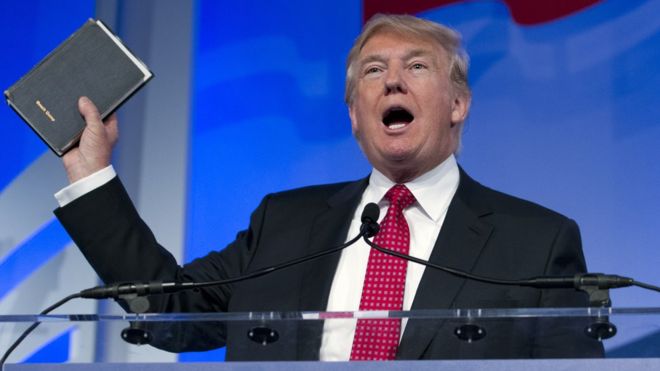
Among all the baffling developments in Campaign 2016, perhaps the one that draws the biggest eye-rolls is Donald Trump’s support among evangelical voters.
The real estate tycoon emerged on the New York scene in the 1970s as a rich playboy who hung out in the discos where sex and drugs were everywhere. He’s famously engaged in affairs, been married three times and previously supported all forms of abortion. And he’s proven that his limited knowledge of the Bible is one of the weak spots in his shtick on the stump.
Yet, he outpolls Ted Cruz (the senator/preacher) with this group of devout Christians. What’s next in this crazy campaign, “Libertarians for Bernie Sanders?”
The National Journal took a look at this bizarre phenomenon and found many ministers in the Bible Belt are just as befuddled by this development as the most secular of political pundits.
The piece in NJ shows that many of the most religious voters in the electorate like Trump’s tough guy rhetoric. They may have been taught to love all of God’s children, but they love it when Trump says he will “bomb the sh– out of ISIS.” They preach monogamy yet they look the other way when it’s reported that Trump years ago boasted to one commentator: “I get more p—- than you.”
One religious leader noted that a segment of the evangelical community has let their disgust with the political status quo override their social values:
“Their frustration has outpaced their discernment. I think it has to do with the depth of thinking about political issues, which sometimes is lacking when you’re frustrated.”
Another minister explained that evangelicals are divided into segments and Trump appeals to those who want a candidate to fight for them, not necessarily one who stands by their side:
“Donald Trump speaks in absolutes, and most evangelicals, we believe in absolutes.”
Yet, even those who believe in religious orthodoxy can get caught up in the heated hyperbole of a Trump stump speech. A third preacher added this:
“Those voters seem to be interested in style, as opposed to specifics.”



A few points:
1) Trump leads with evangelicals, which while prominent are hardly the only sect of Christianity in America. Not all Christians are evangelicals. Moreover, not all Republican primary voters are evangelical. It’s unfortunate that polling forgets this key factor, which means the polls seldom break down demographics by other religious identifiers (say mainline Protestant or Roman Catholic).
2) Conversion and being born-again is central to evangelicalism. Thus, evangelicals are more likely than others to overlook past transgressions. Moreover, evangelicals–and, frankly, most Christians for that matter–believe that God can use anyone, including Trump.
3) Evangelicals are more likely than mainline Protestants and Roman Catholics to wear their faith on their sleeve. They’ve been battered in the culture wars–abortion, school prayer, homosexual marriage, militant secularism (example: calling it “winter break” instead of Christmas break), removing crosses from public grounds. More than anything else, these evangelicals, who believe America’s Christian religious identity has been lost, want a defender of the faith. They don’t necessarily want a theologian-in-chief or pastor-in-chief. Rather, they want someone who will defend them and allow their faith to be expressed and proclaimed in the public square and American daily life, as it was before the 1970s.