Two of the top contractors in Macomb County’s defense
corridor find themselves trying to beat back an attack from the Congressional
Budget Office over plans to build a new Ground Combat Vehicle for the Pentagon.
corridor find themselves trying to beat back an attack from the Congressional
Budget Office over plans to build a new Ground Combat Vehicle for the Pentagon.
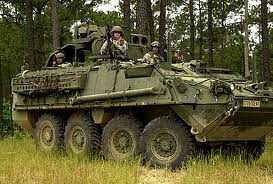
 |
| Stryker vehicle |
General Dynamics Land Systems and BAE, both located in
Sterling Heights, reportedly received 2-year technology-development contracts
of $440 million and $450 million respectively in 2011, for early prototype work
on the Ground Combat Vehicle. But the CBO now says that alternative vehicles
offered by the Israelis or the Germans might be a better, cheaper alternative –
literally, a better bang for the buck.
Sterling Heights, reportedly received 2-year technology-development contracts
of $440 million and $450 million respectively in 2011, for early prototype work
on the Ground Combat Vehicle. But the CBO now says that alternative vehicles
offered by the Israelis or the Germans might be a better, cheaper alternative –
literally, a better bang for the buck.
The $900 million project is overseen by the Army’s Life Cycle Management Command at the TACOM complex in Warren.
Here’s what’s at stake: The Army expects to order about
1,750 GCVs for more than 20 military brigades at a cost of more than $28
billion after a finalized vehicle enters production, starting in 2019.
1,750 GCVs for more than 20 military brigades at a cost of more than $28
billion after a finalized vehicle enters production, starting in 2019.
The CGV will replace the aging Bradley armored vehicles.
BAE officials say the CBO comparisons are based on
outdated information on the capabilities of a “notional GCV.” General Dynamics
representatives have said the CBO’s stats on firepower, survivability or
resistance to attack without crew casualties are “suspect” and contrary to Army
and industry analysis, according to ongoing coverage of the issue by Crain’s
Detroit Business.
outdated information on the capabilities of a “notional GCV.” General Dynamics
representatives have said the CBO’s stats on firepower, survivability or
resistance to attack without crew casualties are “suspect” and contrary to Army
and industry analysis, according to ongoing coverage of the issue by Crain’s
Detroit Business.
Crain’s reported that General Dynamics teamed up with Raytheon
Co. and Bethesda, Md.-based Lockheed Martin Corp. on the design contract, while BAE is
collaborating with Northrop Grumman Corp. and Virginia-based QinetiQ North
America Inc. on that project. Detroit-based Tognum America Inc. is a supplier to both teams.
Co. and Bethesda, Md.-based Lockheed Martin Corp. on the design contract, while BAE is
collaborating with Northrop Grumman Corp. and Virginia-based QinetiQ North
America Inc. on that project. Detroit-based Tognum America Inc. is a supplier to both teams.
Meanwhile, veteran journalist Walter Pincus, in his
column for the Washington Post, is raising questions about the effectiveness
and price of the Stryker vehicle, which is manufactured by GD.
column for the Washington Post, is raising questions about the effectiveness
and price of the Stryker vehicle, which is manufactured by GD.
The basic Stryker has a two-person crew and carries a
squad of nine soldiers. It can travel more than 60 mph on highways and travel
up to 300 miles on its 50 gallon gas tank.
squad of nine soldiers. It can travel more than 60 mph on highways and travel
up to 300 miles on its 50 gallon gas tank.
Last Tuesday, the Army published a pre-solicitation
notice that it plans to award GD a cost-plus-fixed-fee contract for the Phase
II upgrade research and development of the Stryker family of vehicles, Pincus
reported.
notice that it plans to award GD a cost-plus-fixed-fee contract for the Phase
II upgrade research and development of the Stryker family of vehicles, Pincus
reported.
There are two basic versions: an infantry carrier and a
gun system. There are eight other configurations: for reconnaissance; anti-tank
guided missile; for nuclear, biological, chemical and radiological warfare;
medical evacuation; commander’s vehicle; fire support; mortar carrier and
engineer squad vehicle.
gun system. There are eight other configurations: for reconnaissance; anti-tank
guided missile; for nuclear, biological, chemical and radiological warfare;
medical evacuation; commander’s vehicle; fire support; mortar carrier and
engineer squad vehicle.
And there are seven variants of those designs.
In the realities of the Iraq and Afghanistan wars, GD was
forced to make major upgrades to the Strykers based on the emergence of IED
attacks. But more armor means more weight, which means more wear and tear and more
maintenance.
forced to make major upgrades to the Strykers based on the emergence of IED
attacks. But more armor means more weight, which means more wear and tear and more
maintenance.
The more survivable double-v hull models were available within
18 months. But maintenance became even more complex, according to Pincus. The
heavier weight wore out the tires faster. Other newly designed components were
needed to meet failure rates of other parts. And more than 400 Strykers were
damaged.
18 months. But maintenance became even more complex, according to Pincus. The
heavier weight wore out the tires faster. Other newly designed components were
needed to meet failure rates of other parts. And more than 400 Strykers were
damaged.
Pincus concludes:
The United States has spent $17.8 billion on the
Stryker family of vehicles, the GAO report on Defense Acquisitions released
last month said. That’s more than 115 percent higher than original
projected costs. In the past five years, the increases have been running at
23 percent above the initial estimates.
Stryker family of vehicles, the GAO report on Defense Acquisitions released
last month said. That’s more than 115 percent higher than original
projected costs. In the past five years, the increases have been running at
23 percent above the initial estimates.