


A new picture of America has emerged that shows a nation
where most homeowners can comfortably pay the mortgage while many renters
struggle so mightily with their finances that their rent check eats up a
majority of their paycheck.
Some 21 million rental households — or about
half of all renters– spent more than 30 percent of their income on housing
in 2013, according to a report from the Harvard Joint Center
for Housing Studies. About 11 million of those households spent more than half of
their paycheck on rent and utilities, up 37 percent from 2003, the study
found.
That’s well above the prudent levels that financial
advisers typically recommend — spending less than a third of monthly pay on
housing costs.
between renters and homeowners across the country. Renters in the six-county area have a median income
of $28,800 and pay an average rental rate of $830 a month. Homeowners have a
median income of $65,000 yet their housing costs aren’t significantly higher
than renters — $990 a month, on average.
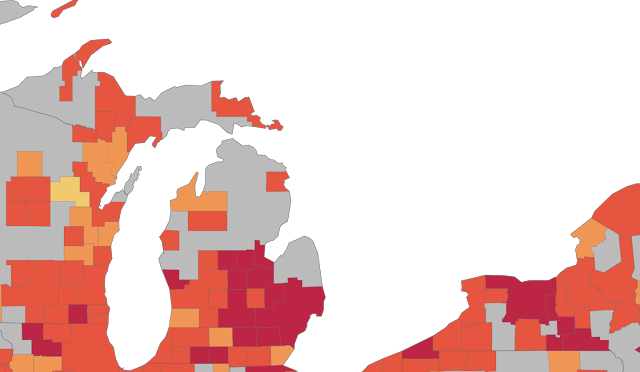
Across Michigan, more than half the renters in a large
swath of 19 counties – all of southeast Michigan plus the entire area south of
Bay City and east of Lansing – live in the in the financially “burdened”
category of the Harvard study – those who spend 30 to 50 percent of their family
budget on housing.The people in the “severely burdened” 50 percent-plus category
are those with low-paying jobs who deal with high rents in what could be called
a “landlords market.” The study found that more Americans are renting than at
any time in the last 20 years, which has made it difficult to find a cheap
apartment.
Another broad section of scattered Michigan counties have 30 to 50 percent of renters in the financially “burdened” category.
(As someone who spent 50 percent of his household
take-home pay on rent as a young, married man, I can tell you that it causes
you to worry about paying your bills and shopping for bargains and devising new
means of thriftiness in an anxiety-filled, emotionally draining manner.)
The map tells the story
The map above that includes Michigan outlines this phenomenon. The gray areas
are counties where insufficient data is available. The red areas are those counties
with 50 percent-plus burdened renters and, on this color-coordinated scaled,
the percentages decline into orange and then yellow hues.
At the same time, Michigan’s homeowners are handling their
housing costs in a relatively easy fashion. The map below shows that mortgages
and other home-related costs comprise less than 30 percent of a family’s budget
for the vast majority in the Upper Peninsula, as well as Jackson and Cass
counties in the Lower Peninsula.
All across the state, most counties have just 20 to 30
percent of homeowners facing housing burdens.
maps, click here.
we see overlapping geography in Michigan between these two classes of people. Most
counties have both homeowners living comfortably and renters struggling to
survive.
The study defined homeowner housing costs as mortgage
payments, property taxes, insurance, any homeowner association or condominium
fees, and utilities. Renters’ costs included monthly rent and utilities.
According to a Washington Post story on the Harvard
report, falling vacancy rates across the nation have lifted rents, improving
the financial performance of rental properties but straining the budgets of
millions of households unable to find units.
“The cheapest apartments are being snapped up quickly,” the Post reports. “The
number of available units nationwide that cost less than $800 a month fell by
12 percent in 2014 from the year before, according to the report. In many
metro areas like Washington, D.C., much of the rental housing being created
consists of luxury apartments, which come with an unexpectedly higher price tag.
most. The number of people making between $45,000 and $75,000 who spent more
than 50 percent of their income on (rental) housing increased by 72 percent
between 2013 and 2003. For people making between $30,000 and $45,000, the
number of renters in that position increased by 69 percent.
“But for people with sufficient savings for a down payment,
it’s a great time to be a homeowner. About 19 million homeowners — about
one in four — spent more than 30 percent of their income on housing in 2013,
the lowest share in a decade.”




Trackbacks/Pingbacks