Among the many flaws in the 2016 presidential campaign is a lack of debate about deep-seeded poverty in America’s inner cities and especially the “eviction epidemic” plaguing single-parent families.
National Public Radio took a look at the affordable housing issue and found staggering numbers of evictions in cities such as Baltimore, Milwaukee, Miami, Cleveland, Indianapolis and St. Louis.
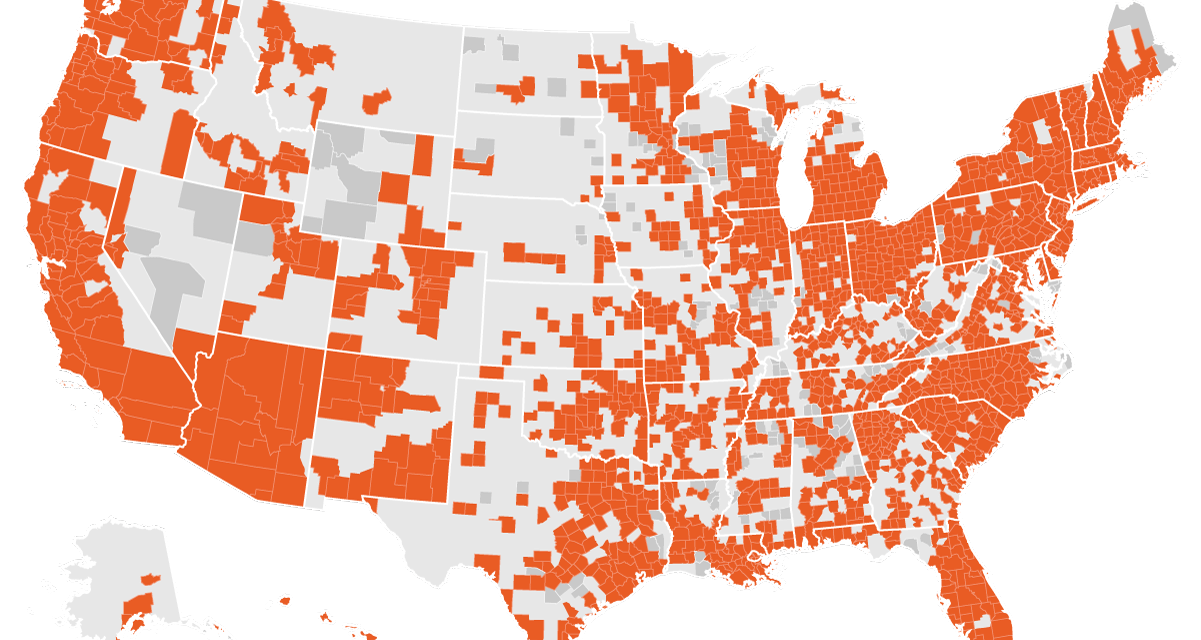
Lack of reasonable rental rates also serve an increasingly ugly problem all across Michigan. (The map above, created by the National Low Income Housing Coalition, shows the U.S. counties where less than half of extremely low-income households have access to affordable housing. )
The Public Justice Center in Baltimore conducted a yearlong study that revealed that most of the tenants who end up in the city’s “rent court” are extremely poor, making $2,000 or less per month. The court handles 150,000 cases a year but most of those facing the prospect of getting kicked to the curb can’t afford a lawyer and there are far too few pro bono attorneys to handle the load.
Only 15 percent of them get housing aid such as vouchers to help cover their rent, according to NPR. Most are African-American women with children who have a high school diploma or less. They also usually lose their cases. One in 17 of the city’s renters is evicted each year.
Mothers with children are the victims
“Mothers with children are really the face of America’s eviction epidemic,” said Matthew Desmond, a Harvard sociologist who spent more than a year with tenants and landlords in two of Milwaukee’s poorest neighborhoods.
Candidates seeking the White House talk about the need for jobs but they rarely talk about wages or that many of the jobs being created by the U.S. economy are low-paying or temporary – or both. In the meantime, affordable housing is being crowded out by high-rises, shopping strips, subdivisions and big-box stores.
The tax incentives and tax breaks needed to remedy this problem don’t seem to be on the agenda of any of the five candidates still in the running. Low-income housing shortages are ignored.
Last year, the Harvard Joint Center for Housing Studies reported that about 11 million households spent more than half of their paycheck on rent and utilities, up 37 percent from 2003.
That’s well above the prudent levels that financial advisers typically recommend — spending less than a third of monthly pay on housing costs.
Lack of low-income housing gets worse
The data for southeast Michigan reflects the divide between renters and homeowners that’s prominent across the country. Renters in the six-county area have a median income of $28,800 and pay an average rental rate of $830 a month. Homeowners have a median income of $65,000 yet their housing costs aren’t significantly higher than renters — $990 a month, on average.
Across Michigan, the amount of affordable housing available has become noticeably worse in the 2000-13 period. On a national scale, this “crisis” is an issue practically everywhere east of the Mississippi River.
In his new book, “Evicted,” Desmond, the Harvard sociologist, details the precarious living conditions of low-income tenants who are routinely overwhelmed by their monthly rent.
NPR reports that one in 11 families expect to be evicted within the next two months. In Milwaukee, most of those evicted have children with an average age of 7.
A report by the National Low Income Housing Coalition presents the bottom line: there are 10.4 million households in the U.S. with extremely low income — earning 30 percent or less of the area’s median family income – yet there are only 3.2 million affordable and available rental homes for this population.