

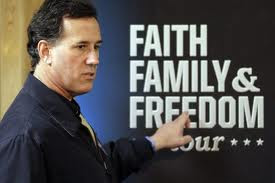
On ABC’s “This Week” this morning, Rick Santorum said that when he read John F. Kennedy’s famous speech in 1960 about the separation of church and state he “nearly threw up.”
Kennedy’s speech in Houston, which was designed to reassure a gathering of Baptist Church leaders that as president he would not take his marching orders from the Vatican, was nauseating to Santorum for one basic reason: it called for an “absolute separation of church and state.”

The former Pennsylvania senator is a Catholic, as was JFK, but he believes that he diverges from the late president because he believes people of all faiths should take part in the national debate, should participate in “the public square.” But then, in his interview with ABC’s George Stephanopoulus, he bastardized Kennedy’s words by claiming that JFK said people of faith do not belong in the public square.
That clearly is not what Kennedy meant. JFK was advocating that debates about public policy be based on secular views and values, not what a church or a pastor dictates.
According to Santorum, people should put their religious and spiritual beliefs, as preached by their chosen church, front and center in the public square.
According to Santorum, people should put their religious and spiritual beliefs, as preached by their chosen church, front and center in the public square.
Which brings us to the many flip-flops – perhaps more properly, moments of sectarian hypocrisy – that have become part of the Santorum track record regarding the Catholic Church.
He is a devout Catholic with seven children who does not believe it is moral to use contraception. On the abortion issue, he strictly follows the church doctrine and is opposed to exceptions in cases of rape or incest, even if the victim is a young teenager.
Yet, when the church’s teachings deviate from his conservative political views – even in matters of life and death – he chooses the Republican Party’s ideology over the Catholic Church’s religious tenets. In other words, a Catholic of convenience.
Here are a few examples:
* Obamacare – Santorum has told crowds at his campaign events for months that one of his first acts as president would be to repeal President Obama’s health care reform law. Though they’re loathe to admit it now in the midst of the controversy over coverage for contraceptives, the U.S. Bishops were outspoken advocates of the health care reform plan throughout the 2-year debate in Washington.
* Welfare reform – On the campaign trail, Santorum repeatedly refers to the restrictions adopted by Congress in 1996 as his signature achievement during his 16 years on Capitol Hill. He says that the bill that passed, though it was the subject of numerous tweaks in the tussle between President Clinton and the House GOP, was legislation that he wrote.
Yet, the Catholic Church strongly disapproved of welfare reform because it was viewed as harsh treatment of the least among us.
* The Iraq War – The Catholic Bishops were as strongly opposed to the war as Santorum was in favor. On the Senate floor he spoke of staying the course and supporting President George W. Bush’s war plan, even through the darkest days of troop losses in 2004-06.
While the church labeled it an unjust war throughout, Santorum, a member of the Senate Armed Services Committee, stuck with the GOP party line, opposing all attempts by Congress to set withdrawal timetables. At one point in the run up to the war, Santorum even said it would not be “morally responsible” to let Saddam Hussein remain in power in Iraq.
* Capital punishment – Santorum has consistently supported the death penalty while the Catholic Church’s opposition is widely preached. Pope John Paul II frequently spoke out against capital punishment. Church doctrine says that the death penalty is against God’s word and in violation of respect for the dignity of human life and divine mercy.
According to ThePoliticalGuide.com, when pressed in an interview in 2006 as to the U.S. purpose and goal in Iraq, Santorum made a controversial statement comparing the war in Iraq to J.R.R. Tolkien’s book, “Lord of the Rings.” He stated that fighting the terrorists in Iraq drew their attention away from the U.S. and placed it on Iraq. He compared this to drawing the attention of the eye of Sauron away from the path of the hobbits.
Maybe Santorum sees the hobbits as a proper analogy when talking about U.S. citizens who must be protected from immorality, as he defines it.
But I don’t think the Catholic Church would approve of that either.


Chad — Let's not confuse U.S. Bishops with Catholicism. Also, Catholics are bound to follow Church doctrine on matters of faith and morals only, not welfare policy, capital punishment, or the war against terrorists. And, it looks like the Bishops learned a valuable lesson about the effect of government intervention in health care.