I have presented thee separate posts in which to delve deep into Texas Gov. Rick Perry’s track record. The buzz surrounding his candidacy has been unprecedented. Since then, I have uncovered more information, particularly based on a web site called polticsmathblog.com that offers a particularly caustic, non-partisan blog.
Much of the information on jobs created during Perry’s 2001-2011 reign is apparently misleading — particularly in regard to pay rates or 21st Century employment.
Here’s the start of the blog, which relies upon hours of research based on Texas economics, plus many hard-to-understand charts:
“I don’t like Rick Perry for our next president. I have my reasons that aren’t worth going into here. However, when I was watching the GOP debate and pro-Perry people started bringing up Rick Perry’s job numbers as a cudgel against other candidates, I looked into the BLS data on Texas jobs.
“Having familiarized myself with the data, I started noticing claims on the Texas jobs data that started popping up that directly contradicted what I was seeing in the data. So I wanted to clear up a couple of these common misconceptions.
“Anyway, let’s deal with the complaints in no particular order:
“Texas has an unemployment rate of 8.2%. That’s hardly exceptional.”
(To see all the charts, click here.)
“See, that’s what I thought when I started looking at the data. I knew that Utah had a lower unemployment rate than Texas and I kept hearing that Texas was go great at jobs, blah, blah, blah, so I looked up the unemployment rate.
“Nothing special.
“So I was going to drive my point home that Texas was nothing special by looking at their raw employment numbers and reporting on those.
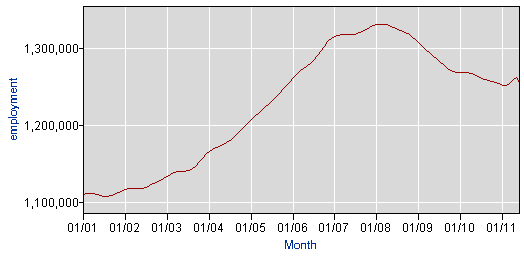
But I’ve been looking closely at employment data for a couple years now and I’ve become very accustomed to seeing data that looks like this (more charts).
“In a ‘normal’ employment data set, we can easily look at it and say ‘Yep, that’s where the recession happened. Sucks to be us.’ But not with Texas. With Texas, we say “Damn. Looks like they’ve recovered already.”
“But if Texas has so many jobs, why do they have such a high unemployment rate? Let’s take a closer look at that data.
“We can see that Texas has grown the fastest, having increased jobs by 2.2% since the recession started. I want to take a moment and point out that second place is held by North Dakota. I added North Dakota to my list of states to show something very important. North Dakota currently has the lowest unemployment rate of any state at 3.2%. And yet Texas is adding jobs at a faster rate than North Dakota. How can this be?
“The reason is that people are flocking to Texas in massive numbers. Starting at the beginning of the recession (December 2007), let’s look at how this set of states have grown in their labor force.
“As you can see, Texas isn’t just the fastest growing… it’s growing over twice as fast as the second fastest state and three times as fast as the third. Given that Texas is (to borrow a technical term) f***ing huge, this growth is incredible.
“People are flocking to Texas in massive numbers. This is speculative, but it ‘seems’ that people are moving to Texas looking for jobs rather than moving to Texas for a job they already have lined up. This would explain why Texas is adding jobs faster than any other state but still has a relatively high unemployment rate.
“Sure, Texas has lots of jobs, but they’re mostly low-paying/minimum wage jobs”
“Let’s look at the data.
“Texas median hourly wage is $15.14 — almost exactly in the middle of the pack (28th out of 51 regions). Given that they’ve seen exceptional job growth (and these other states have not) this does not seem exceptionally low.
“But the implication here is that the new jobs in Texas, the jobs that Texas seems to stand alone in creating at such a remarkable pace, are low paying jobs and don’t really count.
“If this were true, all these new low-paying jobs should be dragging down the wages data, right?
“And it turns out that the opposite is true. Since the recession started hourly wages in Texas have increased at a 6th fastest pace in the nation.
“As a side note, the only blue state that has faster growing wages is Hawaii. Just thought I’d get that jab in since so many people have been making snarky remarks.
“Texas is oil country and the recent energy boom is responsible for the incredible jobs increase.”
“In identifying ‘energy jobs’ I cast as wide a net as possible. When we finally get the data, we discover that energy isn’t really the biggest part of the Texas economy. Increases in jobs in the energy sector (or closely related to it) account for about 25% of the job increases in the last year. Since the energy sector only makes up 3% of all employment, there is some truth to this claim.
“However, take the energy sector completely out of the equation and Texas is still growing faster than any other state. This indicates to us that the energy sector is not a single sector saving Texas from the same economic fate as the rest of the states. It’s not hurting, but Texas would still be growing like a weed without it.
“Texas has 100,000 unsustainable public sector jobs that inflate the growth numbers.”
“I’m not sure where this one comes from, but the numbers are these (and can be found by selecting government employment from the data wizard at this link:
“Counting from the beginning of the recession (December 2007) the Texas public sector has grown 3.8%, or a little under 70,000 employees. This is faster than normal employment, but it’s not off the charts.
“Given that the Texas economy has grown so much and private sector jobs have grown so much, that doesn’t strike me as an unsustainable growth in the public sector.
“But, just in case you’re really worried about it, you can lay your fears to rest because in the last year the Texas public sector has shrunk by 26,000 jobs. In the last 12 months, Texas lost 31,300 federal employees, trimmed 3,800 state jobs, and increased local government jobs by 8,400 jobs.
“(To be fair, this was partially driven by the role Texas employees played in the census, which inflated federal job numbers this time last year. Since the census numbers stabilized, federal employment has been at about break-even.)
“As you can see, we’re nowhere near the “100,000 unsustainable jobs” number.
“My Personal Favorite Chart””
“I mentioned at the beginning that Texas is seeing high unemployment in a large part because they’re growing so damn fast. The problem with this from a charts and graphs perspective is that it leaves worse states off the hook, making them look better than they actually are. Looking at unemployment alone, we would conclude that Wisconsin has a better economy than Texas. But Wisconsin is still 120K short of its pre-recession numbers. The only reason they look better than Texas is because 32,000 people fled the state.
“During that time, 739,000 people fled into Texas. Anyone who takes that data and pretends that this is somehow bad news for Texas is simply not being honest. At the worst, I’d call it a good problem to have.
“So, to give something of a better feeling for the economic situation across states, this chart takes the population of the states I selected above and judges the current job situation against the population as it stood at the beginning of the recession.
“Using that metric, Texas would have a very low unemployment rate of 2.3%. But the fact that unemployment in the United States is fluid means that the unemployed flock to a place where there are jobs, which inflates its unemployment rate (at least in the short term). It’s not a bad thing for Texas… it just looks bad when dealing with the isolated “unemployment %” statistic.
“My advice to anti-Perry advocates is this: Give up talking about Texas jobs. Texas is an incredible outlier among the states when it comes to jobs. Not only are they creating them, they’re creating ones with higher wages.
“One can argue that Perry had very little to do with the job situation in Texas, but such a person should be probably prepare themselves for the consequences of that line of reasoning. If Rick Perry had nothing to do with creating jobs in Texas, then why does Obama have something to do with creating jobs anywhere?
“And why would someone advocate any sort of ‘job creating’ policies if policies don’t seem to matter when it comes to the decade long governor of Texas? In short, it seems to me that this line of reasoning, in addition to sounding desperate and partisan, hogties its adherents into a position where they are simultaneously saying that government doesn’t create jobs while arguing for a set of policies where government will create jobs.
“Or, to an uncharitable eye, it seem they are saying ‘Policies create jobs when they are policies I like. They don’t create jobs when they are policies I dislike.’
“People will continue to argue about the data. But hopefully this will be helpful in sorting out reality from wishful and desperate thinking. I mentioned on Twitter that the Texas jobs situation was nothing short of miraculous. This is why I said that and why I’m standing by that statement.”
Ezra Klein at The Washington Post has a different take regarding Perry’s criticism of the Federal Reserve (He said Chairman Ben Bernanke is guilty of “treasonous” behavior for printing so much money in a time of economic weakness):
“’Quick: What potential policy maneuver is a major presidential candidate calling ‘almost treasonous?,’ Klein wrote. “Is it A) going to war without explicit authorization from Congress, B) doing nothing about the 15 million unemployed even as their temporary joblessness hardens into a structural disadvantage, or C) purchasing long-term Treasury debt in order to push interest rates down?
“If you guessed ‘purchasing long-term Treasury debt in order to push interest rates down,’ you got it. While campaigning in Iowa, Texas Governor Rick Perry gave his take on Ben Bernanke and the potential for a third round of so-called quantitative easing. ‘If this guy prints more money between now and the election, I don’t know what y’all would do to him in Iowa, but we would treat him pretty ugly down in Texas. Printing more money to play politics at this particular time in American history is almost treacherous, or treasonous, in my opinion.’
“If you ignore the implied threat of violence against the head of America’s central bank, Perry’s position is unremarkable in today’s Republican Party. But that is perhaps what is so remarkable about it. The GOP’s turn against monetary policy is one of the most consequential and under-discussed trends in economic policy.
“It was the conservative icon Milton Friedman, after all, who pioneered the argument that the Great Depression was largely the fault of poor monetary policy. His analysis had the dual advantages of being both true and useful to skeptics of government spending. It implied that there were more ways to prevent and respond to recessions than to simply have Congress take out the credit card.
“But as Ramesh Ponnuru writes today in Bloomberg View, since the start of the financial crisis, Friedman’s lessons have been forgotten, and even rejected, by many Republicans, in part because it’s easy to look at the Federal Reserve’s policy and misunderstand it. ‘We don’t have loose money, and we haven’t during our entire economic slump,’” argues Ponnuru.
‘A big reason that slump has been so deep and long is that the Fed is keeping money tight: It’s not letting the money supply increase enough to keep current-dollar spending growing at its historical rate.’”
“The typical answer to this is to point to how the money supply has expanded, or how commodity prices — one signal of inflation — rose earlier in the year (they are falling now). But looking at the money supply on its own tells you rather little.
“You need to look at it in relation to the economy. As for commodity prices, as Ponnuru says, is anyone really willing to contend that ‘we have loose money any time Asian consumption of precious metals increases, or there’s a disruption of the oil market?’
“The danger here isn’t an opportunistic, partisan turn against sound monetary policy. That’s a problem, but it’s also a near inevitability in a two-party system like ours, and given the Federal Reserve’s independence, it’s one that can be mostly ignored. The danger here is a real turn against sound monetary policy that smart Republicans find they can’t quietly abandon when they enter office.
“That’s a world in which a Republican administration will find itself unable to make good nominations to the Federal Reserve, and perhaps even unable to stop Congress from making unwise alterations to the mandate and powers of the Federal Reserve. That’s a world in which the lessons of the Great Depression — and of Milton Friedman — aren’t just forgotten, but are in fact lost.”