
The pre-emptive presidential debate in New Hampshire on
Monday, aimed at upstaging the controversial Fox News gathering on Thursday
that will officially kick off the debate season, was a spectacular flop.
New Hampshire’s Manchester Union Leader newspaper, with
encouragement from papers in the other two states that are traditionally first to
vote — Iowa and South Carolina – tried to keep the early states as the focal
point in the pre-primary/caucus time period.
showed up but the Monday night debate received little press coverage. The media
attention the event did attract seemed to uniformly agree that the gathering
was boring and hampered by limitations designed to avoid Republican National
Committee rules about the 2015-16 debate schedule.
The biggest factor: Donald Trump was a no-show.
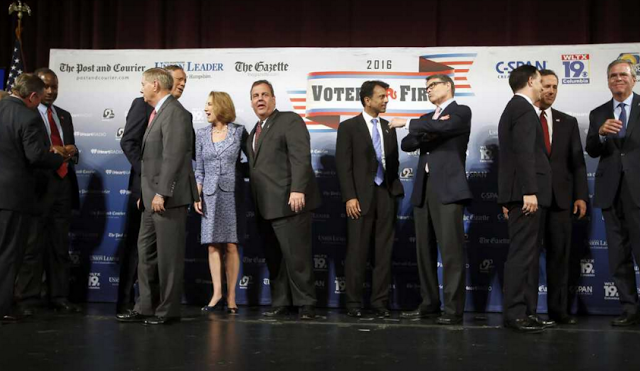
to stand onstage next to each other. That would have been an actual debate. They
sat in chairs in the front row waiting their turn on stage to sit on a bar
stool in fornt of a silent crowd.
One by one, the candidates answered questions from local
talk-radio host Jack Heath. Yahoo reported that they spoke for only four minutes
each, fielding what were almost uniformly friendly questions asked from a
conservative point of view by Heath.
“Republicans here wanted very badly to preempt the first presidential debate on Fox News by
holding a more regionally focused event, to drive home the importance of their
status as an early primary state.
“… But what took place on the campus of Saint Anselm
College was so far removed from the substance of an actual debate that it
wasn’t clear what voters in New Hampshire watching on local TV, or anyone else
watching on C-SPAN, could have learned from the cattle call of candidates.
“… Because of rules put in place by the Republican National Committee to
prevent GOP candidates from having to take part in too many debates that take
up valuable preparation time and that, in the opinion of the RNC, create a
dynamic of ongoing Republican-on-Republican criticism, the forum was fatally
hamstrung.”
description:
“It was a fascinating view of an alternate universe where
there are no insults, talking points reign over candor, and everyone plays by
the slow-moving, old rules of politics. In short, Donald Trump wasn’t
there.
“It wasn’t just that the forum was a sleepy
affair—interrupted only by a few titters from the audience but no spontaneous
applause—the somnolent two hours were free from any stirring remarks by the
candidates. Rather, it was like a speed-editing contest where candidates
listened to the questions and then rushed to find the paragraphs in their stump
speeches that conveyed what they wanted voters to hear without making it appear
as though they had ducked the underlying question.
“That’s the way it normally goes at these things. We
scratch our rake across the barren desert of these gatherings for a moment of
candor or a flash that gives us some insight into the candidates. We’re pushy.
Voters are less so, and for them the event offered some basic introductory
information. They got to hear the biography of some candidates — former CEO Carly
Fiorina started out as a secretary, and Sen. Ted Cruz’s father fled Cuba — and
they heard the boiled-down rationale for each candidate: Gov. Scott
Walker fought for conservative policies in a Purple State, and Gov. John Kasich
balanced budgets while thinking about people on the margins of society.”