

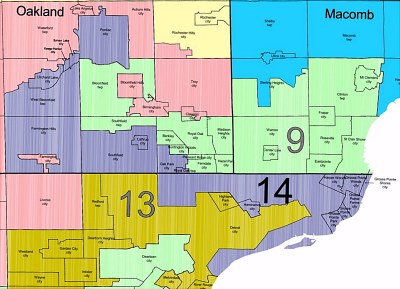
A petition drive to end partisan gerrymandering in Michigan will be announced Friday morning as a newly formed group called Voters Not Politicians hopes to place a state constitutional amendment on the 2018 statewide ballot.
The nonpartisan group proposes an independent commission to draw the lines for legislative districts pertaining to Congress, the state House and the state Senate. The highly political task of drawing a new map every 10 years currently lies with state legislators in the party that, at the time, holds a majority in the Legislature.
Eight states have switched to various forms of a thorough nonpartisan redistricting process, and six others have implemented new systems to keep gerrymandering out of the map-making process for their legislature.
“Our goal is to take political gamesmanship out of redistricting and give this critical task back to the voters through a nonpartisan citizens’ commission,” said Katie Fahey, spokeswoman for the Michigan petition drive..
“… Gerrymandering is a national disgrace, practiced by both political parties whenever and wherever they get the chance. However, elections are a state function, so a national solution is not possible. Reform must be achieved state-by-state. Our goal is to repair the system in Michigan, and give our representation back to the people. Voters, not politicians, should be deciding the outcomes of our elections.”
Election reformers say Michigan voting results since the redistricting process of 2011 reflect the very definition of gerrymandering, as the party in power kept a solid majority despite receiving a modest amount of votes. The squiggly lines carved out by the GOP, based on 2010 Census numbers, essentially allowed Republican incumbent officeholders to choose their territory and preserve their seats.
The partisan advantage of the current maps is apparent. In 2012, Michigan Democrats received 52% of the votes cast for state House, but won 46% of the seats. In 2014, Democratic candidates received 51% of the votes for state House, and won 43% of the seats. In 2016, Democrats received just under 50% of the votes for state House, and again captured just 43% of the seats. And in congressional races in 2016, Democrats received 47% of the votes, but won just 36% of the seats.
Gerrymandering a scam for both parties
Of course, Democrats similarly drew the districts to their advantage when they controlled the Legislature in the 1960s and 1970s.
The nationwide push for eliminating gerrymandering has elevated by leaps and bounds in recent years as court fights, state legislation and ballot proposals demand a redistricting process that is separated from partisan legislators. Yet, the movement in Michigan remains almost entirely a cause among Democratic activists.
On a separate track, Democrats are preparing to challenge in court the gerrymandered legislative districts across Michigan following a potentially landmark judicial decision in Wisconsin that rejected partisan redistricting.
A lawsuit in the works by attorney Mark Brewer will ask the U.S. District Court to strike down the boundary lines drawn by Michigan Republicans for seats in Congress, the state House and state Senate.
The Voters Not Politicians group has scheduled a 10 a.m. press conference Friday to lay out more details of their proposal. So far, they have said that “communities of common interest” should be preserved, not split by legislative lines, and districts should be compact and contiguous. Basic computer software now allows for the effortless creation of district boundaries that are devoid of political bias.
While the group is awaiting public input before determining the makeup of the proposed Citizen’s Redistricting Commission, they have already stated that those ineligible to serve would include current and former politicians, lobbyists, political consultants, major campaign donors and other “political insiders.”
In a clear overture to Donald Trump voters, a news release distributed earlier today by Voters Not Politicians promotes their effort to end “rigged” elections. In this case, that means outlawing gerrymandering practices in which legislative districts produce “safe” districts for incumbents who then avoid competitive races, rendering most November elections wholly inconsequential.
“In the 2016 election for the Michigan House of Representatives, 91 out of 110 races were decided by margins of 10% or larger,” said Davia Downey, a leader of the petition drive and an assistant professor at Grand Valley State University. “In Michigan’s 16 races for Congress, the winning candidates won by a margin of at least 13.7%. Twelve out of the 16 races were decided by more than 15%. Politicians, not voters, are deciding who wins.”
The petition drive hopes to build upon a 2015-16 effort by the Michigan League of Women Voters to put the redistricting issue on the ballot. The LWV held 35 town hall meetings across the state to explain the current mapping process.
The league’s push for a good government approach, the creation of an independent, nonpartisan redistricting commission, never caught on. It didn’t result in a group being formed to lead a drive, in part because campaign funding never surfaced. The LWV had made clear that they lacked the finances to launch a statewide petition drive but no one stepped forward to fill the void.
Evenly divided state, lopsided elections
John Hanieski, another leader of the new petition drive, said that Michigan’s recent lopsided election results stand in sharp contrast to a state that has been fairly evenly divided between Republicans and Democrats for decades.
“Michigan historically has been a middle-of-the-road state, with the two major parties generally receiving virtually the same number of votes for the Legislature and Congress,” said Hanieski, an independent economic consultant and the former chief economist for what was formerly known as the state Department of Commerce.
“(Legislative) and congressional delegations should reflect that fact. In 2016, the difference between the two major parties’ state House vote was just 3,000 votes (0.07%). But the maps drawn by the politicians and their consultants in secret meetings gave one party (the GOP) a 63-47 advantage in the House. Every other election in Michigan in this century has been similarly distorted by the mapmakers.”
Now, Voters Not Politicians vows to collect the required 315,654 valid voter signatures within a 180-day period to put the issue on the ’18 ballot.
Following on the LWV approach, the petition drive has scheduled upcoming town halls in Detroit, Livonia, Marquette, Petoskey, Jackson, Sandusky, Alpena and Houghton Lake. A session in East Lansing on Sunday, prior to the announcement of the ballot proposal campaign, sponsored by the Michigan Election Reform Alliance, attracted a standing-room-only crowd of 650, according to Fahey.
Recent Posts:
 Anti-gerrymandering plan is complete overhaul of…
- Michigan companies can’t fill jobs because too…
- Warren ranked the most ‘white trash’ city in Michigan
- Michigan avoids being Foxconned – Snyder bailed out…
- The recession recovery: Michigan No. 1 while 35…
- Islamophobic SH candidate calls on Michigan Tea…
- Michigan counties face a heavy hurt under…
- Michigan Obamacare rate increases could average 28 percent







Hey Chad,
It’s good to hear someone is taking the reins on this, but I’d like to point out a mistake in your article. The League of Women Voters didn’t try to get a non-partisan redistricting on the ballot in 2016, the were holding information campaigns throughout the state. I know because I’ve been wound up about gerrymandering in Michigan and started making calls to find out who was spearheading a push, and it turned out to be no one. In February of 2016, I spoke with Sue Smith of the Michigan LWV, and we talked about what they had in the works at that time: a state-wide information campaign in which they travelled to cities in an attempt to educate voters. To say that they “failed miserably” to put the issue on the ballot isn’t just factually incorrect, it smears the group. I hope you’ll correct that.
The most recent group that did fail miserably was the Michigan Redistricting Collaborative, which was in 2011.
https://ballotpedia.org/Michigan_Redistricting_Collaborative
Thanks for your work on this important topic.
How do I help?
go to countmivote.org.
Go to “How To Get Involved” and then click “volunteer”!
I’m ready to sign!
go to countmivote.org.
Go to “How To Get Involved” and then click “volunteer”!
How do I find this group so I can volunteer to help? I’ve googled and found nothing about Voters Not Politicians anywhere online!
Please keep me updated so I can help..
The group’s website is VotersNotPoliticians.com.
You can go through votersnotpoliticians, or
go to countmivote.org.
Go to “How To Get Involved” and then click “volunteer”!
I’m stuck in Dave Trott’s gerrymandered district.
You don’t have to be!
You can go to countmivote.org!
“It seems to me that an ‘independent panel’ is about as likely as politicians redistricting themselves out of office. This is the twenty-first century. How hard can it be to create an algorithm to draw legislative districts after each census?” Reader “Bob Munck” agreed: “Why do people need to be involved in mapping the districts?”
They’re right. These programs and algorithms already exist. Quoting Christopher Ingraham from the article “This Computer Programmer Solved Gerrymandering in his Spare Time.
I think that’s a good question! But who will choose the program? People have created dozens of these programs and there are an infinite number of ways to draw a map. What ‘rules’ will the program follow? Who decides on the rules? Who decides on the priority of rules?
For example, a US Congressional district contains about 700K people.
let’s say there is a city with 300K, and a city north of it with 400K and a city south of it with 400K, which city should our 300K city be joined with? Who decides that? How? If the program decides it, it makes that ‘decision’ because the person who wrote the program put it in the code, so, there is still a human element.