

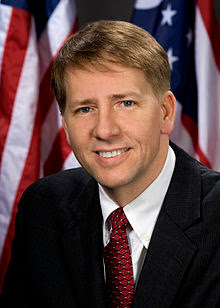

In his speech yesterday in suburban Cleveland, Barack Obama announced his recess appointment of Richard Cordray as the nation’s first “consumer watchdog” and the president praised the Michigan State University grad as the perfect man for the job.
For those who crave excellence in government – rather than partisanship – Cordray is a breath of fresh air.
Senate Republicans had blocked Cordray’s nomination as director of the new Consumer Finance Protection Bureau as a form of protest against the new Wall Street regulations adopted by Congress last year.
“They’ve refused to even give Richard and up-or-down vote,” Obama said. “It’s not because he’s unqualified. There is no question that Richard is the right person for this job. He’s got support from Democrats and Republicans. A majority of (state) Attorneys General from both parties across the country have called for Richard to be confirmed. Your local members of Congress who are here today – they support him. He has the support of a majority in the Senate. Everyone agrees that he’s more than qualified.”
Here’s a summary of Cordray’s impressive resume: Ohio attorney general, Ohio state treasurer, Franklin County (Ohio) treasurer, Ohio state representative.
But Cordray’s early life is just as impressive. After being named co-valedictorian of his high school and graduating from MSU’s James Madison College, Cordray, 52, earned a masters in economics from the prestigious Oxford University in England. From there, he was named editor-in-chief of the University of Chicago Law Review, where he attained his law degree.
After law school, he clerked for the U.S. Supreme Court for a Reagan appointee, and represented the U.S. government before the Supreme Court three times — once for George H.W. Bush and twice for Bill Clinton.
And, oh yes, there is this: Cordray was an undefeated, five-time “Jeopardy!” champion (winning $45,303 on the TV quiz show).
Over at Business Insider, they suggest that Obama was too diplomatic in explaining Cordray’s impressive credentials vs. GOP opposition to his confirmation.
“He doesn’t just go after Wall Street institutions. He goes after individual executives as well,” Business Insider wrote in a post yesterday.
They also offered a summary of Cordray’s 3-year reign as the Ohio AG:
* In 2009, representing several state public pension funds, he reached a settlement with Hank Greenberg and other AIG execs that blew the Securities and Exchange Commission’s settlement out of the water. Cordray got $115 million, the SEC got a mere $15 million.
* The following year, he settled another suit against AIG itself (also for Ohio) for $750 million.
* And then there was the Bank of America/Merrill Lynch merger. Cordray sued on behalf of Ohio pensions on the grounds that BofA concealed billions of dollars of Merrill Lynch losses from their clients before the merger. The case settled for $475 million.
Business Insider added this: When they talked to him about the Merrill/BofA case in 2009, he, of course, explained the reason why he was suing, but also revealed why he’s such a threat. In doing so, I think he effectively summarized the degrading of the nation’s traditional meritocracy that has angered and frustrated so many Americans:
“My understanding of a bonus is that it’s a special reward for superior performance. There wasn’t any superior performance for special reward; nonetheless, they (BofA and Merrill execs) wanted the bonuses.
“They ultimately, as best we know, got approval to pay out somewhere between $3 and $4 billion in bonuses, which was a very material element to the value of the merger. That was not disclosed to investors.
“…We’ve also pursued some of the top executives — not just the corporations themselves. We do think that they bear their share of the blame. We think that they need to be held accountable as well. We think that that’s a principle that sends a message to other corporate executives on Wall Street that is a further disincentive for this kind of thing in the future.”
So, there you have the new sheriff in town. The cop on the beat after Wall Street nearly destroyed the U.S. economy.
“For too long,” Obama said in his speech, “we’ve had a financial system that stacked the deck against ordinary Americans. Banks on Wall Street played by different rules than businesses on Main Street – or a lot of community banks. Hidden fees and fine print led consumers to make financial decisions they didn’t always understand. And all that risky behavior led to an economic crisis that we’re still digging ourselves out of.
“That’s why, last year, we put in place new rules of the road to make sure that a few bad apples in the financial sector can’t break the law, cheat consumers, and put our entire economy in danger. Many of these provisions are already starting to make a difference. And for the first time in history, we put in place a consumer watchdog – someone whose only job is to look out for the interests of everyday Americans.
“Richard is the right man for this job. If you’re a student, his job will be to protect you from dishonest lending practices and make sure you have all the information you need on student loans.
“If you’re a veteran, he’ll help make sure you aren’t taken advantage of when you come home from serving our country.
“And if you’re a senior, he’ll help make sure you don’t lose your home or your retirement because someone saw you as an easy target.”
There are several reasons to frown upon the president’s performance in his first three years in office, particularly his relative lack of leadership.
But in standing up to Congress and boldly making this appointment, despite questions of its legality, the president hit a home run during this trip to the plate.


I'm sure it will be argued for what it truly is, an illegal appointment.