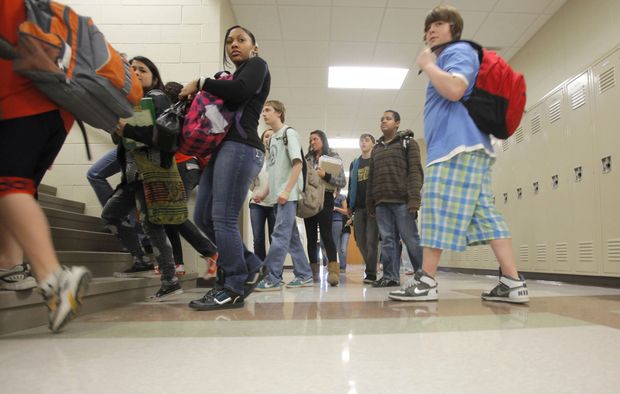
Michigan has just 21 high schools ranked among the 1,000 best in the nation. In other words, 98 percent of the top-quality high schools in the U.S. are not in the Great Lakes State.
A list compiled by U.S. News concluded that Michigan has no schools in the Top 200. Three charter schools ranked the highest – Wellspring Preparatory in Grand Rapids, No. 1 in Michigan, No. 211 nationwide; Arbor Preparatory in Ypsilanti, ranked 2/236; and Black River in Holland, ranked 3/256.
Among public schools, Rochester Adams earned the best ranking at 4/319.
U.S. News is well known for its rankings of the country’s colleges and universities. For the magazine’s list of 22,000 high schools it relied on a few basic metrics: graduation rates, grads’ college readiness, annual academic improvements, and whether at-risk students keep pace.
The Top 50 list for Michigan, amassed by MLive, shows very little geographic diversity. Many of the schools near the top of the list are located in just three counties: Oakland, Washtenaw and Kent.
The third-largest county in the state, Macomb, barely earned a mention. The county’s only school on the list is Eisenhower in Shelby Township (Utica Community Schools), which is rated at 47/1,607.
Of note is the Plymouth-Canton school district in western Wayne County, where all three high schools made the Top 50 list. The Plymouth, Canton and Salem high schools are located on a 300-acre campus where 6,200 kids attend classes.
Overall, the correlation between a community’s personal income and economic prosperity and its schools’ performance seems clear.
A report released earlier this week by Michigan Future Inc., an Ann Arbor research firm, warned that Michigan is stuck in a “low-prosperity state” status. The surest way to reverse that trend, according to Michigan Future, is to improve the state’s education system.
“The education that is provided for affluent kids is, by and large, designed and executed differently than it is for non-affluent kids,” the report said. “One system delivers a broad college prep (dare we say liberal arts) education, the other delivers an increasingly narrow education built around developing discipline and teaching what is on the test, or too narrowly preparing non-affluent children for a first job.”
Recent Posts:
 Website says 80% of Michigan’s best elementary…
- Michigan companies can’t fill jobs because too…
- Warren ranked the most ‘white trash’ city in Michigan
- Michigan avoids being Foxconned – Snyder bailed out…
- The recession recovery: Michigan No. 1 while 35…
- Islamophobic SH candidate calls on Michigan Tea…
- Michigan counties face a heavy hurt under…
- Michigan Obamacare rate increases could average 28 percent