

Republican Sen. John McCain had a characteristically colorful explanation last week
for the Pentagon’s decision to keep the A-10 aircraft active, including those
at Selfridge Air National Guard Base in Harrison Township, at least through
2017.
McCain said that he credits the fight against ISIS and
the terror group’s leader for postponing the retirement of the Air Force’s A-10 Thunderbolt
jet.
“If you had to give the majority of credit somewhere,
I would give it to Mr. Baghdadi in ISIS, because we had to go into Syria. We
had to go after ISIS. The A-10 is still the most capable weapon to do that,”
McCain told the Arizona Daily Star, referring to the head of ISIS, Abu Bakr
al-Baghdadi.
“This is probably the first and last time that I am in league with Mr. Baghdadi.”
The A-10 squadron and support crew from Selfridge,
Michigan’s largest military installation, returned in the fall from a 6-month Middle East mission fighting ISIS.
McCain, Arizona’s senior senator, said the 1970s-era A-10s,
affectionately known as Warthogs, are still proving their worth in battle in Syria
and Iraq.
“I am sure you’ve heard about this spectacular strike
where we hit the fuel trucks, 100 or so of them. You know who carried out that
airstrike? The A-10s,” McCain said. “Still the best close air-support aircraft
in the inventory.”
In the first wave of U.S. airstrikes after the deadly Paris attacks by ISIS in
November, A-10s and AC-130 gunships destroyed a convoy of more than 100 ISIS
oil tanker trucks in eastern Syria, part of a stepped-up effort to cut off a
main source of terror funding.
Air Force officials have repeatedly said retirement of the A-10 fleet would free up funds
for newer planes, like the F-35 Joint Strike Fighter, an ultra-expensive
warplane intended to replace the A-10 and F-16 fighter.
But after trying to idle the battle-tested
Warthog for the past three years, McClatchy News Service reports that Air Force
officials concede that the plane is key to the war on ISIS.
Air Force officials say they still need to retire the A-10 to make room for newer
warplanes, but that the calculus for its sunsetting has been thrown off by military
commanders’ demands for the Warthog now.
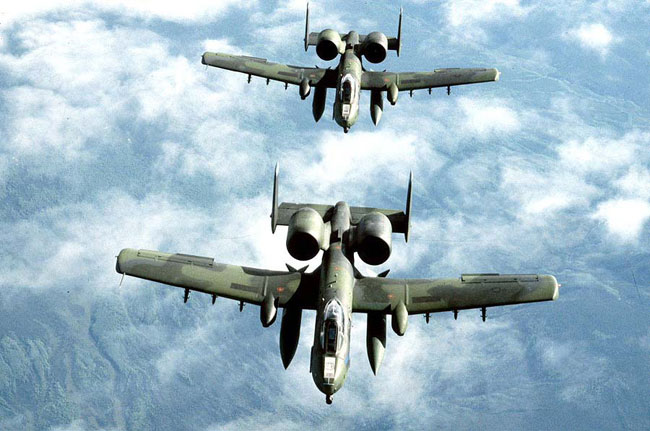
The A-10’s role is to fly low and slow over the battlefield, attacking enemy
troops and destroying tanks and other armored vehicles.
The updated version, the A-10 Thunderbolt II,
features a tough, titanium skin that is able to survive direct hits from armor-piercing
and high-explosive projectiles. When shot up, it just keeps going.
With its cockpit surrounded by a titanium tub and the plane reinforced with
layers of armor, the A-10 has spawned legendary tales of pilots returning from
combat in badly wounded planes that were full of holes and missing an engine,
but still flying.
In addition to their role in the fight against ISIS, A-10s have also been
deployed in Europe to deter Russian aggression and along the Korean peninsula.
Capitol Hill is Rep. Martha McSally, R-Ariz., a former A-10 pilot who flew
combat missions in the 1990s.
“The plane was built to show up on the battlefield, loiter, take hits and survive,” McSally told
McClatchy. “It’s amazing. We can lose a lot of our hydraulics, all of our
electronics, lose one engine and have flight-control damage, yet still fly back
to friendly territory.”
famously said at a prior congressional hearing that an A-10 had once rescued
him while engaged in ground combat. He praised the plane as “the ugliest, most
beautiful aircraft on the planet.” But he said its time has come to be relegated to the Air Force bone yard.





Drunk’ Bhagwant Mann forced to leave bhog