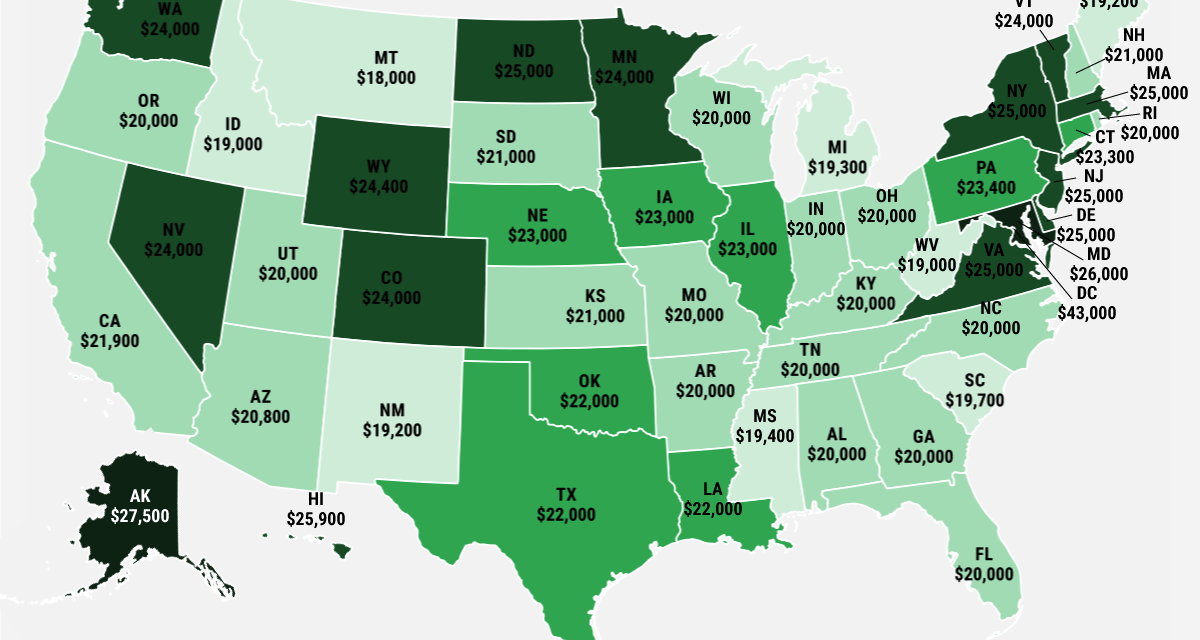
The Millennial generation attracts a constant barrage of criticism, mostly from Baby Boomers, along a wide array of topics, but a new map demonstrating state-by-state earnings among these young adults says this: Maybe we all owe them an apology.
The map, created by Business Insider using U.S. Census figures, shows that in nearly all states the median income of Millennials is around $20,000. That is staggering in the sense that the median level means that half earn less than the $20,000 range.
This is an entire generation struggling financially and feeling left behind.
Even in relatively prosperous states — go-to destinations for college graduates such as California, Texas and Florida – the median Millennial income is between $20,000 and $22,000. In the Upper Midwest, the Rustbelt, the Millennials’ earnings are actually a bit higher. Though Michigan stands at a lowly $19,300. Montana ranks last at $18,000.
The major exception to this surprisingly uniform picture of gloom is Washington. In the District of Columbia, where government-related jobs are plentiful, the median Millennial income is $43,000.
Adjusted for inflation, wages for young adults have fallen steadily since 1979, except for the late 1990s, even more so than the decline experienced in the overall workforce.
To create this map, Business Insider used the most generous definition of Millennial, those between the ages of 18-34 or, in this case, those born between 1981 and 1997. As a result, the income figures don’t just represent kids fresh out of high school or college or those living in mom’s basement.
Many are married or have children. The poverty level for a family of three, it should be noted, is $20,090. The nation’s overall median income for a family of four is $56,516.
This is a story that affects all of us, not just the disgruntled Bernie Sanders supporters who want a “revolution.”
We’ve all heard the stories about the recent college grads with two degrees who are working at the mall or a local restaurant. But these income numbers suggest that a wide swath of young adults is working jobs far below their talent level and, as a result, their purchasing power is minimal. Which only exacerbates the slack in the entire consumer market.
Many of these young people can’t afford a decent car or place to live. If the members of the largest generation in the nation are constantly short on cash and can’t pay their bills, that’s a huge drag on the economy.