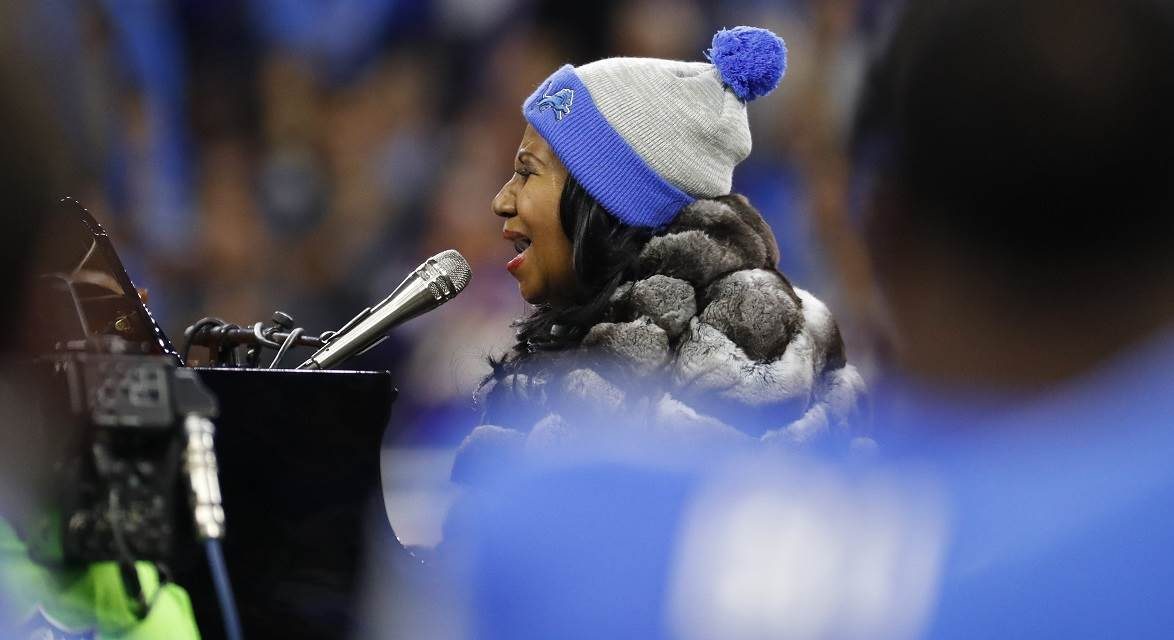
So, our nation faces another matter that is splitting us apart as a people: Was Aretha Franklin’s rendition of the National Anthem at the Detroit Lions’ Thanksgiving Day game stirring, or simply terrible?
On Facebook, innumerable people quickly weighed in to say that the Queen of Soul’s bold 4 ½-minute version was just awful. The implication was that the performance lacked R-E-S-P-E-C-T. Of course, we don’t know how many of those critics were football fans who had already consumed too many beers and were just eager to get the game started.
One key point is that Aretha has been singing “The Star Spangled Banner” in that mode – slow, soulful, a bit bluesy – for many years. I checked back and her widely praised performance of the anthem at the 2008 Democratic National Convention, with a military band-style accompaniment, lasted nearly as long as Thursday’s version – about 4 minutes.
The larger point is that the 85-year-old National Anthem has been performed thousands of times in ways that break from the traditional marching band mode. Rock, jazz, blues, gospel, folk and country performers all have expressed their musical freedom as they tried to make the song their own – often in an attempt to tackle the piece’s multi-octave notes and its lack of rhythmic melody.
To this day, one of the most widely regarded performances of the anthem came at the 1991 Super Bowl, as the Gulf War’s Desert Storm was underway and the nation was alive with patriotism. The performer was a young Whitney Houston, Franklin’s goddaughter, and her gospel-tinged version, with phrasings not unlike those employed by 74-year-old Aretha on Thursday, became a sensation.
The Detroit area very recently experienced another unorthodox version of the anthem when classic rocker Ted Nugent performed at a packed Donald Trump campaign rally at Sterling Heights’ Freedom Hill just two days before the election.
Nugent chose to largely replicate the meandering Jimi Hendrix instrumental interpretation of The Star Spangled Banner, with its sonic blasts of distorted guitar. The Motor City Madman certainly did not deliver the traditionally short version. It was not what one might call a respectful version. But it sparked huge cheers and American flag waving and chants of “USA, USA.”
Nearly half a century ago, when Hendrix broke all barriers with his crackling, subversive Woodstock performance of the anthem, the guitarist and his cheering audience faced accusations across the U.S. of anti-American sentiments.
Fifty years later, diverse interpretations of a simple, iconic song that expresses our collective attachment to the land of the free – for the most part – are welcomed. And, musically, that’s as good as it gets.