
Jeff Spross, a blogger for the liberal site Think
Progress, goes out on a limb in his newest post by attempting to demolish
conventional thinking on the sequester cuts and long-term federal debt.
Progress, goes out on a limb in his newest post by attempting to demolish
conventional thinking on the sequester cuts and long-term federal debt.
“… One might think no serious and responsible American can
ignore the unassailable truth: America faces a debt crisis, which we must act
on immediately and decisively,” he wrote.
ignore the unassailable truth: America faces a debt crisis, which we must act
on immediately and decisively,” he wrote.
“Well, not quite. The actual truth is that the debt
everyone’s freaking out about does not exist.”
everyone’s freaking out about does not exist.”
What kind of left-wing nuttiness is this? Well, hold on.
Spross is not pulling some liberal, utopian vision out of thin air. He offers some
valid, thought-provoking examples of how difficult it can be to project
revenues and spending far into the future.
Spross is not pulling some liberal, utopian vision out of thin air. He offers some
valid, thought-provoking examples of how difficult it can be to project
revenues and spending far into the future.
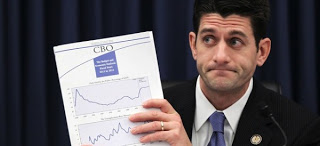
Congressman Paul Ryan, perhaps the ultimate Republican
budget hawk, has repeatedly referred to the Congressional Budget Office’s predicted
debt load in 2037. That’s a look more than two decades into the future.
budget hawk, has repeatedly referred to the Congressional Budget Office’s predicted
debt load in 2037. That’s a look more than two decades into the future.
Here’s Spross:
“Imagine trying to model the 2011 economy in 1985. Things
you’d never see coming include (among other things) the Internet, fracking,
massive advances in computing power, the renewable energy boom, three wars, a
massive recession, and Harry Potter. And predictions can be hard even over shorter
time frames. In 1995, CBO predicted
the deficit in 2000 would be well over $200 billion. We ran a surplus of
$236 billion.
you’d never see coming include (among other things) the Internet, fracking,
massive advances in computing power, the renewable energy boom, three wars, a
massive recession, and Harry Potter. And predictions can be hard even over shorter
time frames. In 1995, CBO predicted
the deficit in 2000 would be well over $200 billion. We ran a surplus of
$236 billion.
“In fact, Ryan plastered dramatic graphs of debt going
out 75 years onto everything in sight while stumping for
his last budget. Forget predicting 2011 in 1985. That’s like
predicting 2011 in 1940.”
out 75 years onto everything in sight while stumping for
his last budget. Forget predicting 2011 in 1985. That’s like
predicting 2011 in 1940.”
Spross uses this premise to question the entire Capitol
Hill process of crafting budgets based on a pile of uncertainties, particularly
the future costs of Medicare and Medicaid.
Hill process of crafting budgets based on a pile of uncertainties, particularly
the future costs of Medicare and Medicaid.
“… The general assumption within the Beltway — that
we’ll write legislation, the CBO will tell us it solves the problem, then we’ll
pass it and the problem will be solved — gets it backwards. The central debt
problem of growing health care costs is something CBO probably can’t tell us
whether we’ve solved until we’ve already solved it.
we’ll write legislation, the CBO will tell us it solves the problem, then we’ll
pass it and the problem will be solved — gets it backwards. The central debt
problem of growing health care costs is something CBO probably can’t tell us
whether we’ve solved until we’ve already solved it.
“Case in point: CBO just significantly downgraded
its projections for Medicare and Medicaid spending over the next decade,
precisely because growth in health care costs has unexpectedly
slowed
to a 50-year low since 2009. A big part of the slowdown is the recession, and
so probably temporary, but lots of economists think
a big part is also durable, structural change to health care markets.”
its projections for Medicare and Medicaid spending over the next decade,
precisely because growth in health care costs has unexpectedly
slowed
to a 50-year low since 2009. A big part of the slowdown is the recession, and
so probably temporary, but lots of economists think
a big part is also durable, structural change to health care markets.”