

 |
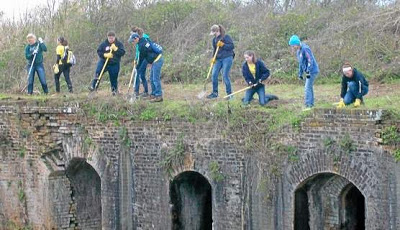
| Hurricane Isaac covered Fort Macomb in Louisiana with eight inches of mud last August. Oakland County students spent their winter break removing the dirt and overgrowth at the 1822 landmark. |
A group of Royal Oak High School students spent their winter break in Louisiana, cleaning up damage caused by Hurricane Isaac, including Fort Macomb, which was named in honor of Macomb County’s namesake, Gen. Alexander Macomb.
The fort, built in 1822, is located about 50 miles southeast of New Orleans. Cathy Kavanaugh of the Royal Oak Daily Tribune, in a story she wrote about the ROHS volunteer project came up with an interesting nugget of information about Gen. Macomb.
Macomb won acclaim during the War of 1812 as a brigadier general who
outfoxed a British force of 10,500 with only 1,500 troops. In the weeks
leading up to the Battle of Plattsburgh on Sept. 11, 1814, Macomb
and his men moved trees and created fake roads that led the British
into dead-end traps. They became sitting-duck targets for the waiting
American soldiers.
Fort Macomb was never the site of a battle. During the Civil War, union troops took it over
after the capture of New Orleans, but not before Confederate soldiers
destroyed the guns and burned the wooden structures.
Although the brick structures have been decaying over the decades, a
portion of the fort’s moat is used as a marina and people like to picnic
there.
After Hurricane Isaac hit in August 2012, some parts of Fort Macomb were covered in
eight inches of mud. The Oakland County students shoveled it up and hauled
it away in wheel barrows. They also pulled weeds that had overtaken the
grounds.
“The public wanted to use it again and now they are within reach to
open in the spring,” said teacher Steve Chisnell, who supervised the work. “We removed all the overgrowth. We
also excavated a brick staircase that was looking more like an earthen
ramp. This helped the historians learn more about the brick restoration
needed.”

