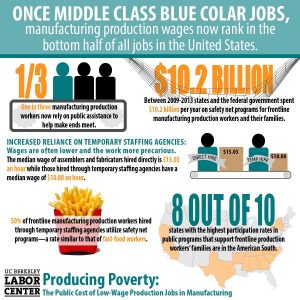
A little more than one-third of factory workers in the U.S. now rely on at least one public assistance program to support their family, costing taxpayers $10 billion annually.
That startling statistic comes from a report released today by the University of California at Berkeley. The researchers found that low wages leading to dependence on government programs is especially acute among those who hold a manufacturing jobs through a temporary agency. Half are on some type of assistance.
“As presidential candidates from both parties debate how to revive American manufacturing, and while lawmakers at the federal and state levels promote subsidies to lure manufacturing jobs, the (UC Berkeley) Labor Center calculates that low wages in manufacturing cost taxpayers approximately $10.2 billion a year in public assistance,” the report said.
The study took a look at the federal and state costs associated with funding assistance for factory workers related to five “safety net” programs with income eligibility requirements: Medicaid, SNAP (food stamps), the Children’s Health Insurance Program (CHIP), the federal Earned Income Tax Credit (EITC), and traditional welfare payments (TANF).
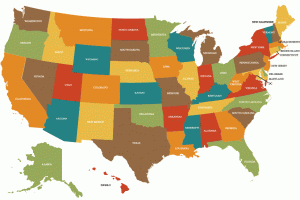
To see an interactive map with public assistance costs in each state, click here.
In Michigan, nearly half of the federal and state money spent on public assistance goes to working families.
The report focuses on the rapid growth in the use of low-paying temporary positions (the so-called “gig economy”), which account for nearly one in 10 frontline jobs in manufacturing, a nine-fold increase from 25 years ago, when less than one percent of production workers were employed through staffing agencies.
Half of these temp workers in blue-collar jobs rely on public assistance, which is just below the 52 percent figure for fast-food workers.
The researchers found that the largest classification of temporary manufacturing workers — assemblers and fabricators — earn a median wage of $10.88 an hour, compared to $15.03 for those hired directly by the manufacturers. The temp workers, for the most part, also receive no benefits.
“Manufacturing has long been thought of as providing high-paying, middle-class work, but the reality is the production jobs are increasingly coming to resemble fast-food or Walmart jobs, especially for those workers employed through temporary staffing agencies,” said Ken Jacobs, chair of the Labor Center and co-author of the report.
“While employment in manufacturing has started to grow again following the Great Recession, the new jobs created are less likely to be union and more likely to pay low wages.”
Additional key findings in the report include:
- Eight of the 10 states with the highest participation rates in public assistance programs that support frontline production workers’ families are in the South; the other two states are New York and California. Mississippi has the highest participation rate, at 59 percent.
- This high use of public safety net programs by frontline manufacturing production workers is due to low wages, not limited work hours. Among those who worked at least 35 hours a week and 45 weeks during the year, the percentage enrolled in one or more public safety-net programs was essentially no less than among factory workers overall.
- Recent National Employment Law Project research found that for the first time in decades, manufacturing wages now rank in the bottom half of all jobs in the country, with the typical production worker in 2013 making 7.7 percent below the median wage for all occupations.
Photo/Michigan Economic Development Corporation