that both the Republican and Democratic parties have favorable ratings below 40
percent – the first time that has happened since Gallup started polling on this
issue in 1992 – it appears that we could be approaching a political world in
which polarization becomes permanent.
The frustrated Dan
Pfeiffer, who recently left his White House job as a senior adviser, said this
in an interview:
can do to change the Republicans’ political situation because they are worried
about a cohort of voters who disagree with most of what the president says. We
don’t have the ability to communicate with them — we can’t even break into the
tight communication circles to convince them that climate change is real. They
are talking to people who agree with them, they are listening to news outlets
that reinforce that point of view, and the president is probably the person
with the least ability to break into that because of the partisan bias there.”
said for congressional Democrats and their core constituencies who inhabit a
world wholly closed off from the Republicans at the right of the spectrum.
As for the new polling
numbers, Gallup notes that the country is “largely displeased with
government’s performance and leadership,” but that usually means one party
or the other bears the brunt of that displeasure more heavily, according to the
Washington Post. And for some time, the Democrats’ brand was superior to the
GOP’s. Now? Both are disliked concurrently.
chicken-and-egg question, The Washington Post explains. Over the recent past, the number
of Americans identifying as political independents has increased. Is that a
response to displeasure with the parties? Is it a reason people are more
willing to express that displeasure?
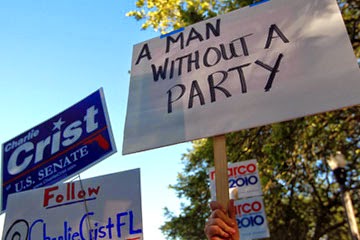
Of course, independents have emerged as the largest voting bloc, consistently more prominent than loyal Republicans or Democrats,
over the past five years. In fact, a September 2014 survey by Gallup found that 58 percent of
voters, and nearly three-fourths of independents, want to an alternative choice,
a third party of some kind.
This trend will only grow
as Millennials are much more likely to consider themselves independent than the
Baby Boomers. Last year, Pew research estimated that 50 percent of the new generation
didn’t affiliate with a party. As Boomers shift out of the electorate and more
Millennials shift in, the Post noted, an independent effect will take hold.
partisan divide in Washington and in the media that is driving all this
discontent, Pew has concluded that there’s no easy way out of this.
“When it
comes to getting news about politics and government, liberals and conservatives
inhabit different worlds,” the Pew study concludes. “There is little
overlap in the news sources they turn to and trust. And whether discussing
politics online or with friends, they are more likely than others to interact
with like-minded individuals.”
The danger here
is that those independent voters who lean left or right will have no place to
go to hear thoughtful discussion about the issues of the day. That could push
them into hardened partisan positions and make the country even more polarized.
overlap in news sources between conservatives and liberals is starkly
demonstrated by a Pew graph. A second, interactive graph amply demonstrates how
Democrats have moved farther left and Republicans farther right since the
watershed election of 1994, making moderates nearly extinct.
Chris Cillizza offers these two graphs on his “The Fix” blog and he ponders the
future of the deep divide dominating our politics:
someone to be elected who can break through across the various, partisan media
outlets to speak in a persuasive way to “the other side”? Sure, in
the sense that anything is possible — and, somewhat more hopefully, because
the one consistent in politics is change. Simply because something is true
today, tomorrow and a year from now doesn’t mean it will be true forever.
“But, what’s clear is that the ability of a president to persuade is deeply
hamstrung by the current political-media climate. That’s not to absolve
President Obama from some blame. When you run on your ability to change
unchangeable things, it’s not unreasonable for you to be judged, at least in
part, on how and whether you succeed or fail in that regard.
deep, structural challenges for Obama and for whoever — Democrat or Republican
— who follows him into office to become the 45th president of the United
States.”