

From my vantage point, it appears that the 2014 Michigan elections are already all but over.
Gov.
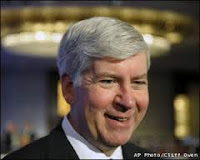
Rick Snyder wins re-election; Congressman Gary Peters captures the U.S.
Senate seat vacated by Carl Levin. Those are the headlines for November
2014. Isn’t it all but obvious at this point?
The partisans,
whether they’re hard-core Democrats or Republicans, will certainly
disagree with half of that prediction. Snyder is a Republican, Peters is
a Democrat. Politics is polarization.
But an objective look, even
16 months before the ’14 vote, surely suggests that former Democratic
congressman Mark Schauer cannot beat Snyder. Similarly, former GOP
secretary of state Terri Lynn Land vs. Peters sounds like a mismatch.
Schauer
has cleared the field in the Democratic gubernatorial primary, so he is
already, in effect, the presumptive nominee. Peters is, without a
doubt, the expected nominee. And Land, who was barely considered a
factor in the Senate race just a few months ago, somehow managed to
maneuver her way into a position where she appears to edge closer to
“consensus choice” status on the GOP side day by day.
Many pundits
and political activists believe Snyder is vulnerable because his
approval ratings remain low, down at 40 percent. Some of Washington’s
top prognosticators list Michigan’s gubernatorial contest as one of the
hottest in 2014, with Snyder considered one of the most vulnerable GOP
governors.
Yet, the inside-the-beltway crowd never quite
comprehends the puzzle that is Michigan politics. They see that Michigan
has gone for a Democrat for president in the last six elections and
they label us a Blue State. But they fail to appreciate that the
Republicans have won four of the last six gubernatorial elections.
Those
who see Schauer as a formidable contender base their judgment largely
on polls that, this far out from the election, cannot be considered
reliable predictors. At this point, Schauer is a clean slate.
It’s
very difficult to defeat an incumbent governor, especially one who can
raise many millions of dollars — and has millions more in his bank
account. Schauer’s name ID with voters is only 38 percent and he’ll need
barrels of cash just to get the electorate familiar with him. Because
he spent many years in the state Legislature, I think the Lansing
political junkies don’t realize just how unknown Schauer is in southeast
Michigan.
The Public Policy Polling surveys
consistently show Schauer with a three- or four-point lead but that’s
before the former congressman has faced any statewide scrutiny. If
Schauer failed to win re-election to his House seat, where he has a
longtime base of support in Battle Creek, it’s reasonable to ask how he
could possibly win a statewide race.
The Snyder campaign will
contrast his executive experience in business and government with
Schauer’s public sector background, meaning he has “never had a real job.”
The “tough nerd’s” biggest advantage, however, may be his ability to use Jennifer Granholm as a foil. How’s that?
While the Michigan unemployment
rate still hovers above 8 percent, there are several economic
categories in which the state ranked at or near the bottom under
Granholm and others where it now ranks among the best.
Though
Granholm has been saddled with far too much blame for the miserable
Michigan economy of 2008-10, Schauer certainly doesn’t want to spend his
campaign defending the last Democratic governor.
Snyder could
probably win the election simply by endlessly repeating this line: “Do
we really want to go back to the days of Granholm?”
As for Peters,
the Bloomfield Township Democrat has emerged as a solid campaigner and
fundraiser who deftly handled the 2012 rigors of having his
congressional district substantially redrawn. He is a solid, if not
spectacular, legislator.
Land, whose base is Kent County, has one
big disadvantage from the start. It’s unlikely voters remember much of
anything about her one claim to fame — eight years as Michigan secretary
of state.
Tim Skubick, dean of the Lansing press corps, recently
engaged in a fairly brutal assessment, describing Land as inarticulate
on state issues and surely less well-versed on national and foreign
policy matters. He recalled Land’s debate performance during her brief
2010 run for governor when she stumbled several times on public policy
questions.
Perhaps as a result, Land has apparently suggested she
may run her Senate campaign largely on Facebook, which would likely be a
disaster with the older voters who are the core GOP constituency in
many parts of the state.
One wildcard as the candidates become
acclimated and the battle lines are drawn is that the disgruntled tea
party groups may run a candidate to the right of Snyder in the GOP
primary. Rumors abound that former state senator Mike Bishop or former
congressman Pete Hoekstra may step up. But those two have had no success
in recent political endeavors and neither is particularly popular with
many tea party groups.
In fact, a tea party-backed challenge to
Snyder that centers on the governor’s refusal to back fringe
conservative causes may be just the ticket to put the incumbent in great
shape heading into the November general election.
Schauer, like
Snyder’s 2010 Democratic opponent Virg Bernero, is a liberal Democrat.
Snyder adeptly won support from independent voters by appearing far more
moderate and pragmatic than Bernero.
Snyder, despite some
controversial moves such as signing the right-to-work law, could be
right back in that comfortable position if the tea party exposes him as
no friend of the right-wingers.
And, in case you’ve forgotten, how did that 2010 race turn out?
Snyder won in a walk, 59 percent to 40 percent.
Recent Posts:
 How low can the bar go in Detroit elections?
- Trump team favors Kid Rock over solid GOP field for Senate
- Michigan companies can’t fill jobs because too…
- Warren ranked the most ‘white trash’ city in Michigan
- Michigan avoids being Foxconned – Snyder bailed out…
- The recession recovery: Michigan No. 1 while 35…
- Islamophobic SH candidate calls on Michigan Tea…
- Michigan counties face a heavy hurt under…