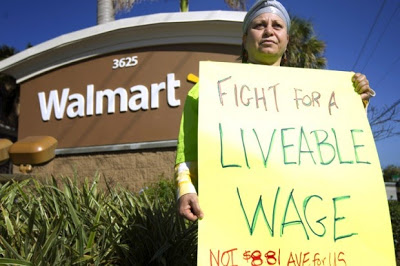

Walmart has stirred up a major controversy in Washington — not Capitol Hill, but in City Hall — by threatening to cancel plans for new stores if the city establishes a $12.50 living wage for “big box” retailers’ workers.
The political pundits who make the nation’s capital their home have weighed in.
Under the headline, “Walmart’s big lie,” Kathleen Geier has a piece on Salon.com that cites several studies which concluded that, when a Walmart store comes to town, it kills as many mom-and-pop shop jobs as the mega-company creates.
“A 2008 peer-reviewed study that looked at Maryland concluded that Walmart’s presence significantly decreased retail employment, by up to 414 jobs (in the community),” Geier wrote. “And a 2009 study by Loyola University
found that the opening of a Chicago Walmart store was “a wash,”
destroying as many jobs as it created: ‘There is no evidence that
Walmart sparked any significant net growth in economic activity or
employment in the area,’ according to the report. “In short, when Walmart
comes to town, it doesn’t ‘create’ anything. All it does is put
mom-and-pop stores out of business.
“But the local studies tell
only part of the story. To get a full picture of Walmart’s disemployment
effect, you need to look at the whole economy, not just local labor
markets. Walmart is a vast and enormously powerful organization: it’s
the biggest company in the country (in terms of revenue), as well as the largest private employer not only in America, but in the world. As such, it has the power to make and break labor markets.
“Many writers and researchers
have looked closely into Walmart’s effect on its suppliers. Here’s what
they found: in its cutthroat drive for lower prices, Walmart squeezes
suppliers to deliver goods at the lowest possible cost. Suppliers who
resist Walmart’s relentless pressure to cut labor costs to the bone risk
having their contracts canceled. Walmart’s demands have driven some suppliers, such as Vlasic, into bankruptcy. It’s forced others, like Rubbermaid, to ship American manufacturing jobs to China and other low-wage countries. Academic studies like this one have documented Walmart’s impact on employment outside the retail sector.”