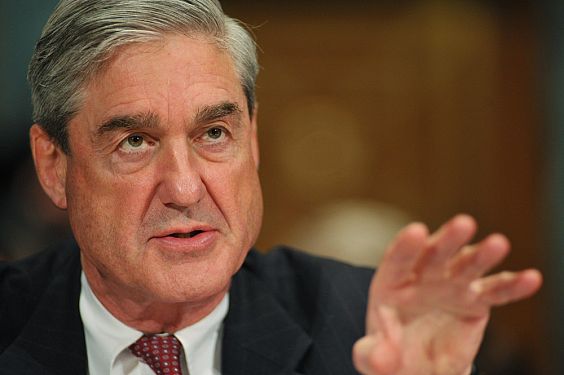
President Trump’s harsh criticisms of the investigations into Russian interference in the 2016 election and his contemplation of firing the special counsel in charge, Robert Mueller, have backfired badly, even among fellow Republicans.
A new CBS News poll shows that 81 percent of voters oppose dumping Mueller and one-third say their opinion of Trump’s handling of the Russia probe has sunk just since March. Among Republicans, 75 percent oppose halting the Mueller investigation and 40 percent believe it’s possible that Trump campaign associates had improper contacts with Russian officials.
Those poll numbers come amidst an intense backlash against Trump’s claims that the Russia investigation has become a “witch hunt.” Key congressional Republicans have rejected that label as it’s become hard to find anyone on Capitol Hill who doesn’t believe the Russians interfered in the 2016 campaign.
Mueller’s appointment as special counsel was quickly greeted with widespread bipartisan support when announced in May. But in recent days a group of Trump supporters from talk-radio and conservative circles have launched strategic attacks on the former FBI director. Leading the charge is former House Speaker Newt Gingrich, who initially called Mueller a “superb” choice for special counsel.
Some news reports indicate that Trump raised the prospect of canning Mueller – or, more specifically, insisting that the assistant attorney general do so – as a misguided attempt to intimidate Mueller.
The New York Times reported that an ally who spoke with Trump about the anti-Mueller initiative, which pleased the president, said it was an attempt to spray intentional ambiguity about Trump’s intentions of firing Mueller. This colleague told the Times that Trump thinks the possibility of being fired will focus the veteran prosecutor on delivering what the president desires most: a blanket public exoneration.
In Trump’s mind, intimidation leads to exoneration.
Obviously, the president still has no clear-thinking approach toward deciding which people in Washington have a much better reputation than the man in the Oval Office.
None other than Ken Starr, the independent counsel for the Bill Clinton/Monica Lewinsky scandal, wrote in a Washington Post Op-Ed column that pushing aside a man of Mueller’s stature would amount to a mistake of historic proportions, one that would spark a constitutional crisis and would serve as “an insult to the Founding Fathers.”
Frankly, the character assassination attempt aimed at the highly regarded Mueller was doomed from the start. Mueller was a registered Republican voter years ago but has enjoyed bipartisan support as an apolitical, hard-nosed prosecutor since he arrived in Washington more than two decades ago.
He was nominated to head the FBI by President George W. Bush in 2001 and was unanimously approved by the Senate. Then, one week later, he endured a baptism by fire perhaps experienced by no other federal official in the past century when the 9/11 attacks hit on Sept. 11.
While Trump’s failure to serve in Vietnam is fraught with, at a minimum, bad PR, Mueller set aside a promising career while graduating from Princeton University to join the U.S. Marines.
According to the Army Times, his valor in Vietnam earned Mueller a Bronze Star, two Navy medals, a Purple Heart, and the Vietnamese Cross of Gallantry.
Years later, in 2016, Mueller received the coveted U.S. Military Academy Sylvanus Thayer Award. Retired Lt. Gen. Larry Jordan, board chairman of the West Point Association of Graduates, explained Mueller’s distinction: “Mr. Mueller’s impressive record in serving our nation is an inspiration, and truly exemplifies the West Point values of ‘Duty, Honor, Country.’ ”
I would suggest that, in the unlikely event that Muller chose to run in the GOP presidential contest in 2016, and he won the nomination and the November election, the vast majority of Republican officials and voters in 2017 would be singing the praises of this ex-Marine’s presidency.
And flashy real estate mogul Donald Trump would exist as merely an asterisk in American political history.
Photo: CNN screenshot