 |
| (Getty Images) |
Last week I wrote a news story about federal employees protesting plans in Congress to reduce the federal deficit largely on the backs of the workers.
At that time, a labor union and an employee association representing federal workers thought they had whittled down the proposed concessions to a 1-year pay freeze and additional out-of-pocket costs for pensions. That would finance $65 billion of the $100 billion price tag for another extension of the payroll tax cut.
Instead, congressional Republicans are renewing the fight against the federal bureaucracy by focusing on the budget “sequesters” that are required after the “supercommittee” failed to come up with a deficit reduction plan. The law that established the supercommittee said failure by the panel would trigger about $1 trillion in spending cuts over 10 years, with half coming from the Defense Department.
On Wednesday, the House voted to extended the federal workers’ current 2-year pay freeze for another year, through 2013. However, the bill did not specify that the savings would be used as an offset to help fund the Pentagon.
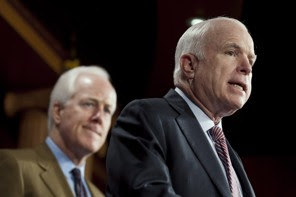
But in the Senate, Sen. John McCain and five other Republican senators unveiled on Thursday a bill that would replace the defense cuts for 2013 with concessions and job cuts for federal employees.
According to The Washington Post, the legislation would replace the $109 billion in defense cuts by: extending the federal employee pay freeze through June 2014; and restricting federal hiring to only two employees for every three leaving, until the size of the federal government workforce is reduced by five percent through attrition.
I have written in the past that the federal workforce should suffer concessions – pay cuts, benefit cuts, staff reductions – just like state and local governments (and teachers) have endured for several years.
But there’s a couple problems with McCain’s bid to hold the Defense Department harmless from budget cuts, as the Post points out.
First, it relies upon a budget gimmick by sparing the Defense Department of cutbacks in 2013 by imposing civilian workforce changes that would make up the difference over the next 10 years.
Second, the bill would still leave about $491 billion in triggered defense cuts that would begin in 2014.