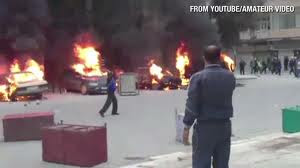

As Syria slips into full blown war, those writers who know the Middle East well caution that America’s options there are limited, and should not include arming the outgunned rebels battling the Syrian army. But one comparison to U.S. intervention in 1999 in Kosovo is intriguing.
Fareed Zakaria wrote this for CNN.com:
“For now, I think we should continue isolating the Syrian regime. We should help Syria’s opposition politically and perhaps economically. I would not, however, advocate arming the rebels or embracing any other kind of military role for the United States. That is a big leap and it is not clear that military intervention will succeed.
“First of all, such intervention would be viewed as unilateral. It would be very different from the situation leading up to the Libyan intervention, which came after the Transitional National Council in Libya, the Arab League, and the United Nations endorsed it and after the Europeans agreed to do the heavy lifting.
“We have to think carefully about when and where the U.S. uses its military power. It should be in places where we feel the costs are not high, the dangers are not huge, and the likelihood of success is reasonable. There is no point in getting involved in a military intervention that is going to be a fiasco, ultimately won’t work, or will backfire.
Zakaria’s column is here.
*****
Tom Friedman of the New York Times warns of a very diverse, complicated demographic mix in Syria:
“…I have no doubt that many of the Syrians mounting the uprising against the Assad regime — which is dominated by a Shiite offshoot known as the Alawites, who make up about 10 percent of the country — are propelled by a quest for a free and pluralistic Syria. But have no illusions: Some are also Sunni Muslims — who are the majority there — seeing this as their chance to overthrow four decades of Alawite minority rule. Where win-win democratic aspirations stop in Syria and rule-or-die sectarian fears begin is very hard to untangle.
“…There is a lot of pent-up anger there. The Assad family has run Syria as an Alawite mafia syndicate since 1970. While the Assad clan may have been a convenient enforcer at times for Israel and the West, it has also been a huge agent of mayhem — killing Lebanese journalists and politicians who dared to cross Syria, arming Hezbollah, funneling insurgents into Iraq, serving as a launching pad for Iranian mischief, murdering its own people seeking freedom and spurning any real political and economic reform. Syria has no future under Assad rule.
“But does it have a future without them? Can this multisectarian population democratically rule itself, or does it crack apart? No one can predict. The Syrian opposition is divided, by sects, by politics, by region, by insiders and outsiders. We need to support them, provided they come together on a pluralistic reform agenda. Opposition leaders owe that to the brave Syrian youths who have taken on this regime bare-handed. The only chance of President Bashar al-Assad agreeing to some kind of peaceful transition, and not endless civil war, is if he is faced with a real united opposition front. It’s also the only hope for reforming Syria.”
Friedman’s column is here.
*****
Fouad Ajami of the Hoover Institution, writing in the Wall Street Journal, makes the parallel with Kosovo and urges Obama to tak bold action:
“… (Obama) would be wise to consider the way Bill Clinton dealt with the crisis of Kosovo in 1999. Not unlike our current president, President Clinton wanted nothing to do with Kosovo when that last of the wars of Yugoslavia erupted with fury in early 1999.
“American power, it should be recalled, had rallied to the defense of the Bosnians four years earlier. The horror of Bosnia had gone on for 30 cruel months, under George H.W. Bush and President Clinton alike. Legends were told about the might of the Serbs, but they were broken with relative ease and the Bosnians were rescued when President Clinton decided that American honor was sullied by the genocide in that corner of Europe—and he unleashed the power of NATO’s bombers.
“… For President Clinton, it was yet another plunge into the Balkan inferno. He authorized a NATO air campaign against Serbia that began on March 23, 1999, the very same day a bipartisan majority in both houses of Congress voted to support it. Two days later, President Clinton spoke to the American people and laid out the stakes in that conflict—the future of Europe, the line to be drawn for brigands and killers challenging the order of nations.”
Ajami’s column is here.