In his speech to the Democratic National Convention in
September, Bill Clinton warned that the Mitt Romney campaign was lacking
in the area of basic arithmetic.
The former president referred to
Romney’s tax cut plan, but he could have just as easily cited the
Romney camp’s failure in Electoral College math. Unlike the conventional
wisdom, I would suggest that the Republicans’ weaknesses can be
pinpointed in rural Red States like Wyoming, Utah, Oklahoma and Kansas.
As
establishment Republicans thrashed the Romney campaign with
breathtaking speed (by political standards) in the 10 days following the election, the widespread
gnashing of teeth focused on the GOP nominee’s “47 percent” comment,
compounded by his post-election claim that President Obama bought the
election by showering government “gifts” upon his favorite low-income
constituencies. Running mate Paul Ryan blamed “urban” voters for the
loss
Within hours or days after President Obama declared victory,
big-name conservatives had quickly pivoted to the middle, declaring that
immigration reform is needed, and additional tax revenues must be part
of any plan to avoid the “fiscal cliff.” In the process, Romney’s bold
tax cut plan and many of the supposedly winning ideas put forward by the
Romney-Ryan team were tossed onto the trash heap of presidential
campaign hyperbole.
The blunt message from current and former
Republicans governors – from Bobby Jindal and Chris Christie to Jeb Bush
and Haley Barbour — was that the GOP tent must expand and diversify if
it seeks to profit at the ballot box in 2016.
In near unanimity,
political analysts pointed out that emerging U.S. demographics expose
the GOP as a party of white men while Democrats scored well on Election
Day with women, Hispanics, young voters and blacks.
But I wonder
if the party’s problem is that they have come to rely too much on
America’s rural voters at the expense of typical suburbs like Macomb and
Oakland counties.
Post-election interviews with officials and
voters in neighboring Oakland County – once a rock-ribbed GOP stronghold
– indicate that Obama won there, especially among women voters, in part
because suburban, cosmopolitan Republicans want a return to political
moderation. They’re turned off by the Republicans’ embrace of tea party
politics.
From a geographical standpoint, GOP stalwarts nationwide
look at the Electoral College map from Nov. 6 and wonder how their
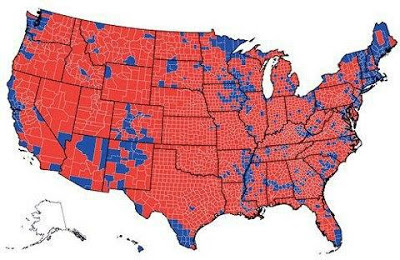
presidential candidate lost. Worse yet, the county-by-county election
results (see map above) show a sea of red stretching from Idaho to Georgia, from Utah to Kentucky.
But if Republican strategists study the numbers, it
becomes abundantly obvious that the GOP should no longer pay heed to the
rural states of the West and the Great Plains.
The staunch
conservatism in that stack of states from North Dakota down to Oklahoma
and northern Texas — with Wyoming, Idaho, Montana and Utah tossed in —
has distorted clear thinking on the Republican side of the aisle.
The
Republicans can afford to create some distance between those Plains and
Mountain State voters without risking anything. The degree of GOP
support there is overwhelming, so there is no reason to fear a damaging
disconnect with the party base or the impact of a low turnout.
As
the Rural Party, the GOP approach has maintained huge majorities in
those nine rustic states for a few decades. In January, those
non-battleground states will provide nearly 40 percent of the Republican
senators on Capitol Hill. But the 21st Century math works against their
partisan caucus in winning the White House.
Consider this:
•
In Alfalfa County, Oklahoma, Romney captured a stunning 85 percent of
the vote. But he accomplished that margin by accruing 539 votes. In
comparison, each of 24 precincts in one Macomb County community, Clinton
Township, produced more than 539 votes for Barack Obama.
• In
San Juan County, Utah – a huge county with a geographic reach that
probably exceeds the Metro Detroit tri-county area – Romney won
comfortably with 58 percent, or 3,006 votes. But it’s only fair to point
out that in the city of Fraser, Obama beat that tally with 3,946 votes.
•
In Wyoming, Romney garnered nearly 70 percent of the electorate, adding
more than 170,000 votes to his overall Election Day total. But that
statewide result fell short of Obama’s haul in Macomb County alone by
30,000 votes.
No cherry-picking is needed here – similar results can be found in every rural state, including some in the South.
These
sparsely populated territories are dominated by people driven by
nostalgia and regressive politics, many of whom enjoy living a 19th
Century lifestyle. They fit comfortably into the rigid GOP base of
xenophobic whites living outside the mainstream, embracing the red-meat
rhetoric of the “Republican Entertainment Complex” on TV and talk-radio.
It should also be noted that these states have populations lacking
minorities, single women and college graduates – the very demographic
blocs that have emerged as a Democratic advantage, despite some of
the Dems’ strident political positions.
It is the voters and
senators and representatives of those states that help push the GOP into
foolish, archaic policies such as making an issue of contraceptives, or
opposing an abortion-exception for rape, or stubbornly fighting against
same-sex marriage. They also encourage Republican hypocrisies on
generous farm subsidies and tax credits for ethanol.
Twenty years
ago, Bill Clinton dragged the Democratic Party back to the mainstream in
the 1990s and showed that he could ace Electoral College math.
Certainly,
the GOP does not want to take its cue from Clinton. But they better
find somebody who knows how to make the numbers add up.
Recent Posts:
 Michigan companies can’t fill jobs because too…
- Educators put a happy face on dreadful test scores
- Obamacare in a ‘death spiral?’ GOP and Berniecrats…
- RNC reportedly discusses eliminating ‘bad guy’ Yob…
- How low can the bar go in Detroit elections?
- Islamophobic SH candidate calls on Michigan Tea…
- Could Trump-induced mess in Washington lead to a new…