 |
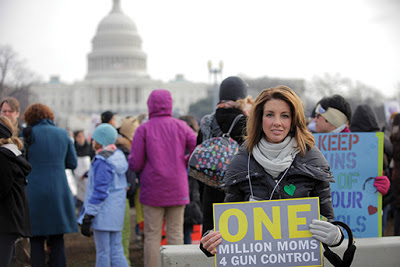
| (Shannon Watts, founder of Moms Demand Action) |
The New Republic has written a provocative – and perhaps prescient – piece about
the rapidly changing landscape within the gun control/rights debate in
Washington. The new gun control groups, partnering with the longtime activists,
have accumulated lots of grassroots support and plenty of cash for TV
advertising in the months since the Newtown shootings.
In
this effort, they are mirroring NRA tactics of past decades, becoming much more
aggressive and making it clear that they will be targeting pro-NRA Democrats
for defeat in the 2014 congressional elections.
the NRA overplayed its hand in opposing the highly popular Senate bill that
would have expanded background checks, MacGillis writes, and because Wayne
LaPierre’s army of lobbyists now faces serious political competition from the
other side, their days as a Capitol Hill powerhouse may be numbered.
This
new united front by the gun control groups is led, of course, by New York City
Mayor Michael Bloomberg and his Mayors Against Gun Violence group, which has
grown to nearly 1,000 members. Bloomberg’s new super PAC has already run a
series of ads against some senators who voted against the Manchin-Toomey
background checks legislation.
At the
same time, former congresswoman Gabby Giffords new gun-control PAC has raised an astonishing $11 million from 53,500 donors in the past four
months.
And then we have Shannon Watts, a political
neophyte who formed a group called “One Million Moms For Gun Control” on
Facebook in the wake of the Newtown massacre. Within
one day, it had 1,000 “likes”. By week’s end, it had 7,000. Now known as Moms
Demand Action, it has 100,000—with 100 chapters in 40
states.
NRA, first and foremost, represents the gun manufacturers, MacGillis notes that
old assumptions about the NRA’s political firepower are giving way to shifting
realities. The scary aspects among members of Congress of facing NRA opposition
are some of the “oldest and least-tested assumptions in Washington,” MacGillis
writes.
more a matter of entrenched wisdom than actual fact. Gun ownership is declining — from half of
households in the 1970s to a third today. A slew of senators and governors have
won campaigns in red or purple states despite NRA F ratings, including Tim Kaine (Virginia), Kay Hagan
(North Carolina), Sherrod Brown (Ohio), Claire McCaskill (Missouri), and Bill
Nelson (Florida), who has campaigned on gun control but has won majorities even
in deeply conservative Panhandle counties. Senator Chris Murphy, a rookie
Connecticut Democrat who has taken a lead on the issue since the Newtown
massacre, points out that, of the 16 Senate races the NRA
participated in last year, 13 of its candidates lost. ‘The NRA is just all
mythology,’ he says. ‘The NRA does not win elections anymore.’
reality is that, for many years, the NRA has had no real opposition. This has
given the debate a strange quality: For gun-control advocates, the recent
challenge has been less about persuading politicians on policy grounds and more
about trying to convince them that the conventional wisdom about gun politics
is wrong.
seeing mass shootings come and go without any attempt to fix gun laws, but
after Adam Lanza killed 20 children and six adults at Sandy Hook, something
really did change. At long last and against all expectations, a viable movement
for gun regulation is emerging. It is a development that not only bodes ill for
the gun lobby and its Republican patrons, but will also complicate matters for
elements of the Democratic Party who have been content to accede to the status
quo. The narrow defeat of the background-check bill, it turns out, was not the
end of hopes for gun reform, but the beginning.”
Meanwhile, the
folks over a Third Way, a centrist website, have put together a nice infographic
on the impact of the Manchin-Toomey vote. After the Senate defied public
opinion and failed to pass background checks, their constituents noticed. This
infographic illustrates the consequences on net approval rating: Senators who
voted no have seen their ratings plummet, while those who had the courage to
vote yes have risen in the eyes of the public (with the minor exception of Sen.
Kay Hagan).
View the graphic here.