Michigan’s
economic picture continues to improve, though not at the pace of 2010 when the
state emerged strongly from the Great Recession.
economic picture continues to improve, though not at the pace of 2010 when the
state emerged strongly from the Great Recession.
The
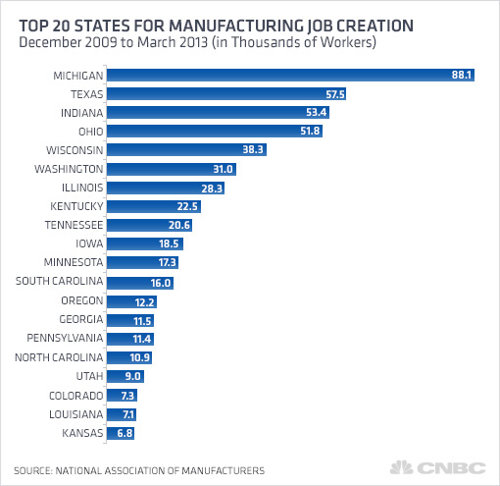
good news is that Michigan led the nation, by a fairly wide margin, in
generating new manufacturing jobs from December 2009 to March 2013, according
to the newest info compiled by Business Leaders for Michigan.
good news is that Michigan led the nation, by a fairly wide margin, in
generating new manufacturing jobs from December 2009 to March 2013, according
to the newest info compiled by Business Leaders for Michigan.
The
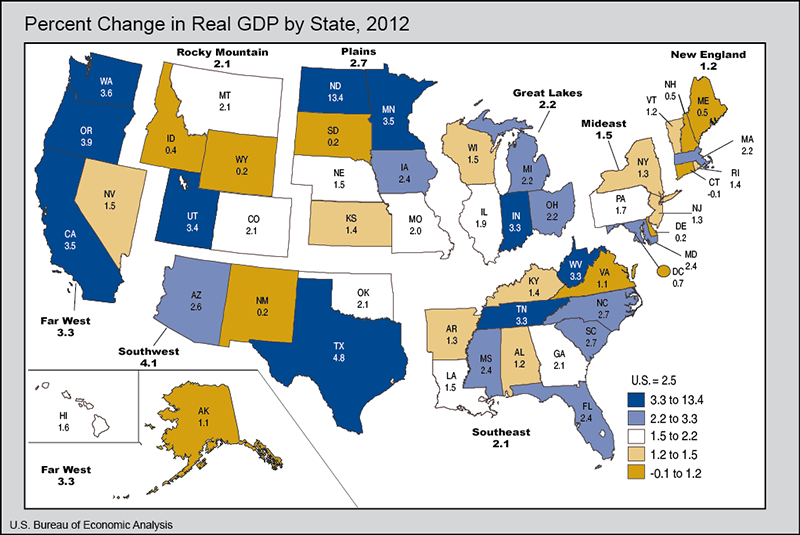
not-so-good news is that Michigan’s GDP growth slowed considerably in 2012 from the
previous year, according to BLM, which relies upon data released by the U.S.Bureau of Economic Analysis.
not-so-good news is that Michigan’s GDP growth slowed considerably in 2012 from the
previous year, according to BLM, which relies upon data released by the U.S.Bureau of Economic Analysis.
Michigan’s GDP growth in 2012
was 2.2%, down from 3.5% in 2011 and 4.9% in 2010. The 2012 growth rate
is slightly below the U.S. average of 2.5% and ranks us 18th nationally.
Michigan’s slower growth rate is partially due to coming off a higher base than
we were a few years ago and the plateauing of manufacturing’s rapid
resurgence.
was 2.2%, down from 3.5% in 2011 and 4.9% in 2010. The 2012 growth rate
is slightly below the U.S. average of 2.5% and ranks us 18th nationally.
Michigan’s slower growth rate is partially due to coming off a higher base than
we were a few years ago and the plateauing of manufacturing’s rapid
resurgence.
Within the Great Lakes region Michigan performed as well or
better than all states but Indiana. Nationally, the west coast and energy
states saw the highest rates of growth.
better than all states but Indiana. Nationally, the west coast and energy
states saw the highest rates of growth.
The Mackinac Center notes that, since the recession ended
in June 2009, Michigan has had the sixth-highest job growth in the nation
at 6.4 percent, trailing North Dakota at 21.6 percent, Utah at 9.5
percent, Texas at 9.3 percent, Tennessee at 6.8 percent, and Indiana
and Colorado, which tied for the fifth spot at 6.6 percent. The Mackinac folks
also cite information from the Bureau of Labor Statistics.
in June 2009, Michigan has had the sixth-highest job growth in the nation
at 6.4 percent, trailing North Dakota at 21.6 percent, Utah at 9.5
percent, Texas at 9.3 percent, Tennessee at 6.8 percent, and Indiana
and Colorado, which tied for the fifth spot at 6.6 percent. The Mackinac folks
also cite information from the Bureau of Labor Statistics.
On the other hand, Michigan’s unemployment rate was 8.4
percent in May, which was ninth highest in the nation. Nevada led the U.S. with
an unemployment rate of 9.5 percent. Michigan’s unemployment rate peaked at
14.2 percent in August 2009.
percent in May, which was ninth highest in the nation. Nevada led the U.S. with
an unemployment rate of 9.5 percent. Michigan’s unemployment rate peaked at
14.2 percent in August 2009.
According
to CNBC, manufacturing jobs in the U.S. appear to be coming back —
if ever so slightly. Several American firms, including Caterpillar, GE and Ford
have announced they are shifting some manufacturing operations back to the United States,
mainly because of increasing production and energy costs overseas.
to CNBC, manufacturing jobs in the U.S. appear to be coming back —
if ever so slightly. Several American firms, including Caterpillar, GE and Ford
have announced they are shifting some manufacturing operations back to the United States,
mainly because of increasing production and energy costs overseas.
And since January of
2010, the United States has added 520,000 manufacturing jobs, according to the Bureau of Labor Statistics.
There are currently 12 million manufacturing jobs on record in the United
States. But the U.S. is clearly in catch-up mode.
2010, the United States has added 520,000 manufacturing jobs, according to the Bureau of Labor Statistics.
There are currently 12 million manufacturing jobs on record in the United
States. But the U.S. is clearly in catch-up mode.
One advantage the U.S. has for manufacturers is lower
energy costs-thanks in no small part to an ongoing boom
around natural gas found in shale formations.
energy costs-thanks in no small part to an ongoing boom
around natural gas found in shale formations.
Here’s the really bad news, as reported by Yahoo: A study
released last year by the Information Technology & Innovation Foundation
(ITIF) concluded that manufacturing in the U.S. declined more in the last
decade than it did in the Great Depression.
released last year by the Information Technology & Innovation Foundation
(ITIF) concluded that manufacturing in the U.S. declined more in the last
decade than it did in the Great Depression.
The ITIF says that translates into some 5.7 million lost
jobs in manufacturing- at an “average loss of 1,276 manufacturing jobs
every day for the past 12 years.”
jobs in manufacturing- at an “average loss of 1,276 manufacturing jobs
every day for the past 12 years.”
In fact, in January 2012 there were more unemployed
Americans (12.8 million) than there were Americans who worked in manufacturing
(just under 12 million) the ITIF said.
Americans (12.8 million) than there were Americans who worked in manufacturing
(just under 12 million) the ITIF said.
Recent Posts:
 Will Detroit get Amazon’s 50,000 jobs? Analysis…
- Michigan companies can’t fill jobs because too…
- Warren ranked the most ‘white trash’ city in Michigan
- Michigan avoids being Foxconned – Snyder bailed out…
- The recession recovery: Michigan No. 1 while 35…
- Islamophobic SH candidate calls on Michigan Tea…
- Michigan counties face a heavy hurt under…
- Michigan Obamacare rate increases could average 28 percent