 |
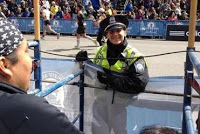
| (Cottone/Boston Globe photo) |
 |
| (Foley, Sdoia/Boston Globe) |
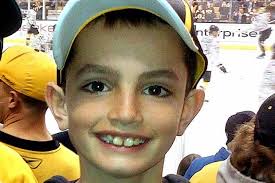 |
| (Richard) |
 |
| (Fenway Park on Saturday) |
Given all the embarrassing moments for the media since
Monday, I would be remiss if I didn’t share some of the best journalism, in my
mind, that has been offered over the past week that reflects on the Boston
bombings.
Friedman, a former longtime foreign correspondent who has witnessed numerous bombing
scenes overseas. Friedman salutes the evolving resolve of Americans since
9/11 in the aftermath of a terrorist attack:
“Let’s schedule another Boston Marathon as soon as
possible. Cave dwelling is for terrorists. Americans? We run in the open on our
streets — men and women, young and old, new immigrants and foreigners, in
shorts not armor, with abandon and never fear, eyes always on the prize, never
on all those “suspicious” bundles on the curb. In today’s world, sometimes we
pay for that quintessentially American naïveté, but the benefits — living in an
open society — always outweigh the costs.
“Terrorists know that, of course, and feed on it. The
explosives were reportedly packed into six-liter pressure cookers, tucked into
black duffel bags and then left on the ground. That is the signature of modern
terrorism: to turn routine items from our lives into bombs: the shoe, the
backpack, the car, the airplane, the cellphone, the laptop, the garage door
opener, fertilizer, the printer, the pressure cooker — so that everything and
everyone becomes a source of suspicion.
“This can pose a much greater threat to our open society
than the Soviet Red Army ever did — if we let it — because this kind of
terrorism attacks the essential thing that keeps an open society open: trust.
perhaps best known for his novel “Mystic River.” Lehane salutes his beloved
hometown of Boston and their resolve during this tragedy:
“Bostonians don’t love easy things, they love hard things
— blizzards, the bleachers in Fenway Park, a good brawl over a contested
parking space. Two different friends texted me the identical message yesterday:
They messed with the wrong city. This wasn’t a macho sentiment. It wasn’t ‘Bring
it on’ or a similarly insipid bit of posturing. The point wasn’t how we were
going to mass in the coffee shops of the South End to figure out how to
retaliate. Law enforcement will take care of that, thank you. No, what a Bostonian
means when he or she says ‘They messed with the wrong city’ is ‘You don’t think
this changes anything, do you?’
keep ourselves safe because of this. We won’t cancel next year’s marathon. We
won’t drive to New Hampshire and stockpile weapons. When the authorities find
the weak and terminally maladjusted culprit or culprits, we’ll roll our eyes at
whatever backward ideology they embrace and move on with our lives.”
As the media succumbs to the urge to psychoanalyze the Chechen-influenced Tsarnaev
brothers, an eye-opening column on the relatively obscure central Asian website
registan.net, a site that is highly critical of Vladimir Putin’s Russia, offers
several subtleties and detailed caveats as reporters try to piece together the
motive for these attacks.
I came across this column by Matthew Kupfer thanks to
Dylan Ratigan’s blog on Politico.
Here’s a little taste:
bombers’ social media profiles to gather information on them. Social media
offers a look into how a person chooses to represent himself online. It can
tell us a lot about a person, or it can tell us very little. It all depends on
the account, the amount of information, and that information’s veracity. In
situations like this, it can be a good source of information if used properly.
into the mold of the stereotypical “Islamic fundamentalist bomber,” the media
used several facts and claims about the brothers that, in my opinion, don’t
ring true or were taken out of the Chechen and post-Soviet context and, thus,
were misunderstood. I would like to draw attention to several such facts
(certainly not all) and clarify them. While these details may seem small, they
helped to form an image of the Tsarnaev brothers in the public’s mind,
simplifying complex motivations that may exist behind this attack. Words have
connotations beyond their direct meanings, and so the choice of something as
small as the wrong word can change how we perceive the facts.
de-contextualized facts in the media coverage of the Boston Marathon bombing is
to emphasize that much information has been misunderstood due to lack of
knowledge about the Caucasus or Russia and a desire to present the suspects in
a framework easily understandable to the American public
“… But we will never even begin to answer the important
questions surrounding this bombing and to see the subtleties of this story if
our media tries to fit each terrorist into an easily understandable,
two-dimensional framework.”
*****
account of what two first-responders, a veteran firefighter and a young police
officer, experienced at the scene:
Engine Company 21 on Columbia Road, saw a woman who had taken off her belt. ‘Gimme
the belt,’ he barked, his instincts taking over. ‘I need more belts,’ he told
the dazed spectators around him, kneeling down to cinch one tight around a
young man’s badly injured leg.
“Cottone, 27, a native New Yorker who fell in love with
Boston as a student at Northeastern, bent over the woman on the ground, her leg
also badly damaged, whose bleeding was proving harder to stem. She pulled the
woman’s I.D. out and scanned the card for her name: Roseann (Sdoia).
“‘I swear it’s there,’ Cottone told her, taking her hand,
calling her by name, resolving to give her hope, no matter how unlikely that
her leg could be saved. ‘I swear on my life, your leg is there.’”
in the first blast. Why is that things like this seem to happen to some of the
nicest people?
Here’s a few excerpts:
Jane, had been seriously injured in the Monday bombing. Jane, a tomboy who had
won a kid’s race the day before the marathon, lost a leg. She might have lost
her life were it not for the immediate assistance from first responders
force behind reviving the (Dorchester) square, complete with restaurants,
offices, and even a new train station. He has been joined in this effort by his
wife, who is also the librarian at the nearby Neighborhood House Charter
School.
Irish song and laughter and all that killers hate. The kids played ball and
hockey out back and rode bikes out front, with Jane trying so hard to be like
Martin. The whole family was always volunteering for something that made
the neighborhood a little better: clean-ups, benefit cookouts, Little League.”