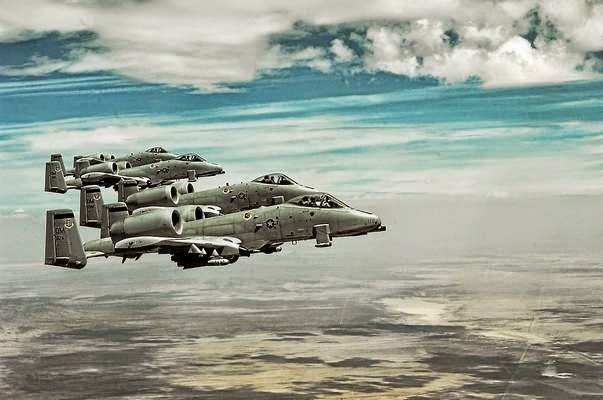
The implications are thick with irony – the A-10 aircraft that the Air Force brass have tried for years to kill, to send to the military boneyard, may be just the weapon to help defeat the ISIS terror group without exposing large numbers of U.S. ground troops to combat.
On the battlefield, the A-10s, such as those stationed at Selfridge Air National Guard Base in Harrison Township, pave the way for ground troops by obliterating enemy military vehicles and inflicting mass casualties. These low-flying “tank killers,” the A-10 Thunderbolts, may be just what’s needed in Iraq and Syria beyond traditional air strikes.
In Washington, a bipartisan effort by several members of Congress calls for a change in strategy with the deployment of A-10s in the war against ISIS. The Pentagon has quietly made plans to send a dozen A-10s, supported by 300 Indiana Air National Guard personnel, to the Middle East in a few weeks.
At the same time that the Air Force continues pushing a $4 billion savings plan to eliminate these unique jets, affectionately known as “Warthogs,” lawmakers make the case that the A-10 is perfectly suited for the mission against ISIS.
Sen. Kelly Ayotte, a New Hampshire Republican, has argued that battling ISIS requires the kind of close air support that only the A-10s can provide, not just bombs dropped from high altitudes or missiles fired from many miles away.
Some experts have also chimed in, saying that the Cold War-era A-10 could quickly destroy the tanks that the Islamic State in Iraq and Syria captured from the Iraqi army, according to The Hill, a Capitol Hill newspaper.
Ayotte noted the Iraqis have already deployed the SU-25 ‘Frogfoot’ — the inferior Russian version of the A-10 – to provide close air support in the battle against ISIS.
Army Chief of Staff Gen. Ray Odierno has testified in Congress that the A-10s performed “incredibly well” in Afghanistan and the Iraq war. He and other Army brass have repeatedly said that the A-10 is trusted and beloved by the troops. And there’s little doubt the A-10s would also earn the admiration of Kurdish, Iraqi and possibly Arab-nation troops on the ground in Iraq and Syria.
Of course, if the Air Force had prevailed, the 107th Fighter Squadron at Selfridge would no longer exist. That unit, known as the Red Devils, has existed since 1917. It currently flies and maintains 20 to 24 A-10s that have been deployed several times to Iraq and Afghanistan. It should also be noted that the unit employs about 450 Guardsmen and nearly 180 active-duty personnel.
The A-10s, which cost about $12 million each when production was halted in 1989, are parked at Air National Guard bases across the U.S. Meanwhile, the F-22 fighter, a weapons system with a checkered past, finally made it into combat for the first time last week in air strikes over ISIS-controlled portions of Iraq. That plane carries a price tag of $150 million each.
While the Obama administration insists that no U.S. “boots on the ground” will be needed to defeat ISIS (also known as ISIL, also known as the Islamic State) it seems likely that, at a minimum, special forces will be needed to take the fight directly to the militants.
If the A-10s are added to the mix, that could minimize the number of U.S. troops put into harm’s way. The Warthogs would also make the Iraqi and Kurdish forces much more effective, limiting casualties as well. Perhaps the biggest role for these jets with the unique capability to fly “low and slow” is to convince neighboring Arab nations – Saudi Arabia, Jordan, the UAE – that their ground troops would not face combat in Syria that devolves into a bloody quagmire.
The updated version, the A-10 Thunderbolt II, is a rather extraordinary aircraft. It features a tough, titanium skin that is able to survive direct hits from armor-piercing and high-explosive projectiles.
When shot up, it just keeps going. The aircraft is designed to fly with one engine, one tail, and half of one wing missing.
Online videos demonstrate that the Warthog’s Gatling gun is absolutely frightening. Each round fired by the 30 mm cannon, located at the nose of the plane, is about the size of a beer bottle.
Those airmen who have flown the A-10 refer to its four-rounds-per-second bursts of gunfire as the “brrrrrt.” The plane is also known for the distinctive whistling sound of its twin jet engines.
U.S. Rep. Candice Miller, one of the staunchest supporters of the A-10 on Capitol Hill, explained that our troops know when the Warthogs are coming – and they’re relieved. The enemy knows when the Warthogs are coming — and they’re terrified.
In war, that’s what’s expected of weaponry. The Warthog may be old. It may have been on its death bed a few times in the past couple of years.
But, sadly, it may be the rise of a monstrous group like ISIS that revives the A-10.