The highly partisan voters who make up most of
the electorate during primary elections have increasingly become hateful toward
those in the other political party.
the electorate during primary elections have increasingly become hateful toward
those in the other political party.
Compared to 20 years ago, many more voters –
devoted Republicans and Democrats — have a “very unfavorable” view of their
rivals. In fact, a majority of these die-hards believe that those in the opposition
camp present a danger to the country.
devoted Republicans and Democrats — have a “very unfavorable” view of their
rivals. In fact, a majority of these die-hards believe that those in the opposition
camp present a danger to the country.
What’s more, these hyper-partisans don’t want to
live near or congregate with the political enemy. And the more politically
active the voter, the more bitterness is expressed toward the other side.
live near or congregate with the political enemy. And the more politically
active the voter, the more bitterness is expressed toward the other side.
Those are
some of the findings of a treasure trove of information released today by the
nonpartisan Pew Research Center. The data was compiled after a 1-year study of
voters’ views, based on a survey of 10,000 Americans.
some of the findings of a treasure trove of information released today by the
nonpartisan Pew Research Center. The data was compiled after a 1-year study of
voters’ views, based on a survey of 10,000 Americans.
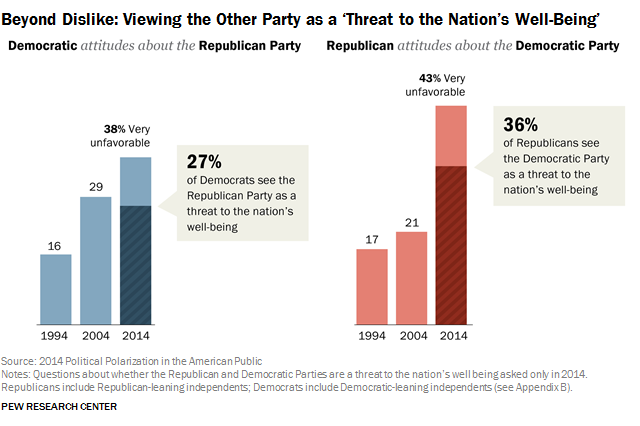
Perhaps the most
disturbing aspect of the Pew research is, in terms of voter “antipathy,” the
share of Republicans who have very unfavorable
opinions of the Democratic Party has jumped from 17 percent to 43 percent in
the last 20 years. Similarly, the share of Democrats with very negative
opinions of the Republican Party also has more than doubled, from 16
percent to 38 percent.
disturbing aspect of the Pew research is, in terms of voter “antipathy,” the
share of Republicans who have very unfavorable
opinions of the Democratic Party has jumped from 17 percent to 43 percent in
the last 20 years. Similarly, the share of Democrats with very negative
opinions of the Republican Party also has more than doubled, from 16
percent to 38 percent.
Here’s how to best put
this mean-spirited polarization into focus: Among Republicans and Democrats who
have a very unfavorable impression of the other party, the vast majority say
the opposing party’s policies represent a threat to the
nation’s well-being.
this mean-spirited polarization into focus: Among Republicans and Democrats who
have a very unfavorable impression of the other party, the vast majority say
the opposing party’s policies represent a threat to the
nation’s well-being.
These angry fringies (my word) who now dominate
our politics and have led to hyper-partisan gridlock in Washington have created
their own form of cultural bigotry.
our politics and have led to hyper-partisan gridlock in Washington have created
their own form of cultural bigotry.
According to Pew, “ideological
silos” are now common on both the left and right. People with down-the-line
ideological positions – especially conservatives – are more likely than others
to say that most of their close friends share their political views. Liberals
and conservatives disagree over where they want to live, the kind of people
they want to live around and even whom they would welcome into their families.
silos” are now common on both the left and right. People with down-the-line
ideological positions – especially conservatives – are more likely than others
to say that most of their close friends share their political views. Liberals
and conservatives disagree over where they want to live, the kind of people
they want to live around and even whom they would welcome into their families.
Of course, these hardliners are not normal – or at least they’re not a
part of mainstream America.
part of mainstream America.
Their sentiments are not shared by all – or even most – Americans.
The majority do not have uniformly conservative or liberal views. Most do not
see either party as a threat to the nation. And more believe their
representatives in government should meet halfway to resolve contentious
disputes rather than hold out for more of what they want.
The majority do not have uniformly conservative or liberal views. Most do not
see either party as a threat to the nation. And more believe their
representatives in government should meet halfway to resolve contentious
disputes rather than hold out for more of what they want.
Yet many of those in the
center remain on the edges of the political playing field, relatively distant
and disengaged, while the most ideologically oriented and politically rancorous
Americans make their voices heard through greater participation in every stage
of the political process.
center remain on the edges of the political playing field, relatively distant
and disengaged, while the most ideologically oriented and politically rancorous
Americans make their voices heard through greater participation in every stage
of the political process.
According to the Pew report, consistently liberal and consistently conservative voters choose
candidates who look like them, and by the time the American public at large
starts paying attention to a campaign, there’s no one left in the race who
looks like them. So, they’re left to either vote for someone on their left
or their right, or they tune out and hand the reins to their angrier and more
partisan compatriots. Until more people start voting in primaries, the people
America elects are going to continue growing more partisan and more unwilling
to work with the opposition.
candidates who look like them, and by the time the American public at large
starts paying attention to a campaign, there’s no one left in the race who
looks like them. So, they’re left to either vote for someone on their left
or their right, or they tune out and hand the reins to their angrier and more
partisan compatriots. Until more people start voting in primaries, the people
America elects are going to continue growing more partisan and more unwilling
to work with the opposition.
Many of the partisans
are likely unaware that they are in the minority. Sixty-three percent of
consistent conservatives say that most of their friends share their political
views. Forty-nine percent of consistent liberals say the same. Consistent
partisans are also more likely to say that living in a place where most people
share their political beliefs is important than those of more mixed ideological
views. Consistent partisans are consuming media that reinforces their
worldview. When your world is largely composed of things you agree with, it
becomes less surprising that the opposition seems more foreign and threatening.”
are likely unaware that they are in the minority. Sixty-three percent of
consistent conservatives say that most of their friends share their political
views. Forty-nine percent of consistent liberals say the same. Consistent
partisans are also more likely to say that living in a place where most people
share their political beliefs is important than those of more mixed ideological
views. Consistent partisans are consuming media that reinforces their
worldview. When your world is largely composed of things you agree with, it
becomes less surprising that the opposition seems more foreign and threatening.”
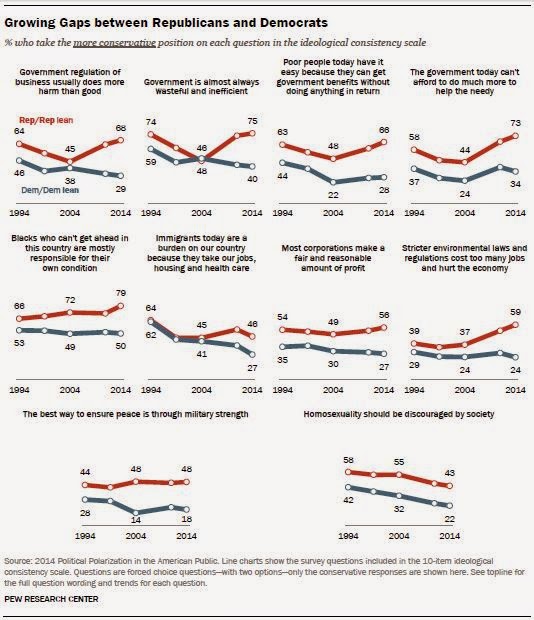
As the above charts show, on issue after issue,
Pew found a growing gap – no middle ground – between the consistently
conservative and the consistently liberal.
Pew found a growing gap – no middle ground – between the consistently
conservative and the consistently liberal.
Over at The Washington
Post’s “The Fix” blog, here’s how they tallied up the numbers:
Post’s “The Fix” blog, here’s how they tallied up the numbers:
Government regulation? Most polarized in 20
years.
years.
Aid for the poor? Most polarized in 20 years.
Corporate profits? Most polarized in 20 years.
Environmental regulations? Most polarized in
20 years.
20 years.
The numbers are pretty staggering:
· * Of the 10 issues Pew asked about, Americans
are more polarized than they were 20 years ago on all 10 of them
are more polarized than they were 20 years ago on all 10 of them
· *In eight of the 10 cases, the gap between
Republicans and Democrats is about twice as big — or bigger — than it was in
1994
Republicans and Democrats is about twice as big — or bigger — than it was in
1994
· * In eight of 10 cases, Americans are more
polarized than they have been at
any point over the entire 20-year period
polarized than they have been at
any point over the entire 20-year period
There is plenty of data out there showing how
polarized Congress is and — accordingly — how little it gets done.
polarized Congress is and — accordingly — how little it gets done.
But to some extent, Congress is an extension
of the polarization that exists in the American people. And as this poll shows,
members of the two American political parties increasingly disagree on
basically any ideological question you could pose to them.
of the polarization that exists in the American people. And as this poll shows,
members of the two American political parties increasingly disagree on
basically any ideological question you could pose to them.
That’s not exactly a recipe for political
compromise or getting things done.
compromise or getting things done.