The percentage of families in the middle class declined in nearly nine out of 10 major metropolitan areas across the country between 2000 and 2014, according to new research by the Pew Research Center.
In the Detroit area, the middle class now barely makes up a majority of the workforce, with just 51 percent earning middle class incomes.
The Pew study defined middle class households as those making between two-thirds and twice the national median income. That means between $42,000 and $125,000 a year for a family of three in 2014, though Pew researchers made adjustments for the cost of living in different areas.
Combined with previous analysis by Pew, the middle class has shrunk from nearly two-thirds of households (61%) in 1970 to about 50% in 2015.
Relying on data for Detroit-Warren-Dearborn, what the U.S. Labor Department calls a “metropolitan statistical area,” the new report shows that low-income families rose from 21.2% to 28.1 % from 2000-14. At the same time, upper income households dropped from 23.8% to 20.5%.
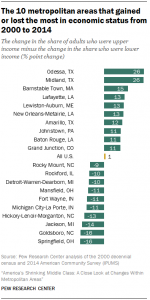
That put the Detroit area among the 10 worst in its decline of “economic status.” The Jackson area finds itself in similar dire straits.
As the chart below shows, the downward push on income, with about 10% of families moving into a lower category, puts the tri-county area at N0. 8 among those metro areas with the largest declines.
Here’s an explanation from the Pew report:
Although other factors may also be at work, the 10 metropolitan areas with the greatest losses in economic status from 2000 to 2014 have one thing in common—a greater than average reliance on manufacturing. Most of these areas, such as Springfield, OH, and Detroit-Warren-Dearborn, MI, are in the so-called Rust Belt. The areas not in the Rust Belt, such as Rocky Mount, NC, and Hickory-Lenoir-Morganton, NC, are also industrial communities.
These areas generally experienced a significant drop in manufacturing employment from 2000 to 2014, ranging from 23% in Fort Wayne, IN, to 51% in Hickory-Lenoir-Morganton, NC, compared with 29% nationally. The jobs lost in manufacturing were not entirely picked up elsewhere as overall private sector employment also fell from 2000 to 2014 in these 10 metropolitan areas, ranging from a decrease of 3% in Goldsboro, NC, to a decrease of 25% in Hickory-Lenoir-Morganton, NC. In contrast, private sector employment in the U.S. overall increased 5% from 2000 to 2014.