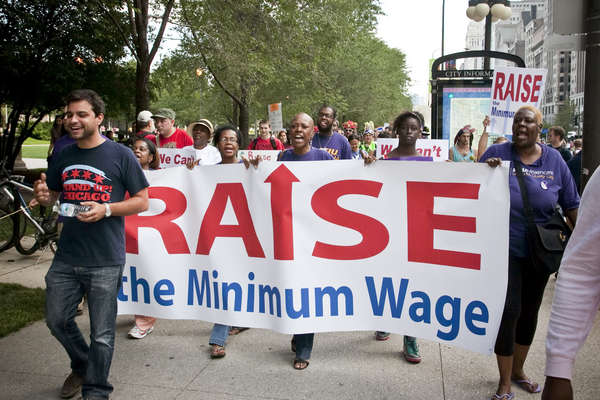
A poll leaked to the media found that the vast majority of business executives support raising the minimum wage.
The Washington Post reported on leaked documents obtained by a liberal group, the Center for Media and Democracy, which counter the widespread claim that a higher minimum wage hurts the business community.
The poll of the Council of State Chambers of Commerce, conducted by Republican pollster Frank Luntz, found that 80 percent of respondents said they supported raising their state’s minimum wage, while only eight percent opposed it.
“That’s where it’s undeniable that they support the increase,” LuntzGlobal managing director David Merritt told state chamber executives in a webinar describing the results, noting that it squares with other polling they’ve done. “And this is universal. If you’re fighting against a minimum wage increase, you’re fighting an uphill battle, because most Americans, even most Republicans, are okay with raising the minimum wage.”
The advocacy organization Small Business Majority found that 60 percent of small-business owners supported raising the minimum wage to at least $12 per hour, and the American Sustainable Business Council also found that a majority of businesses support raising the minimum wage.
One chamber executive explained to the Post why the internal survey differed sharply from the vocal opposition expressed by some business owners to minimum wage hikes. Within chambers and other business groups, the industries that care most about a given policy matter — hotels and restaurants, in the case of the minimum wage — drive the organization’s agenda.
“Usually the most vocal members of the state chambers dominate on that particular issue, and everybody else stays quiet,” said Frank Knapp, president of the South Carolina Small Business Chamber of Commerce.
The survey of 1,000 business executives across the country by LuntzGlobal also found substantial backing for requirements that businesses offer paid paternity leave, which 82 percent of respondents supported, and more paid sick leave, which 73 percent supported.