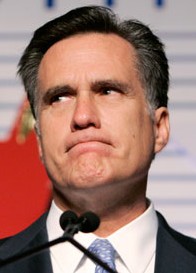
 Mitt Romney may not know it, but his past views on health care reform are part of the evidence put into the record at the U.S. Supreme Court to argue in favor of Obamacare.
Among the 136 briefs filed with the high court for or against the Affordable Care Act is one that was written in support of the law, as outlined by a virtual who’s who of health care economists and scholars. That brief relies in part on an Op-Ed piece written by the former governor in 2006 for the Wall Street Journal which boasts about the Massachusetts health care reforms.
Here’s a portion of that brief:
“Virtually all Americans will at some time during their lives require health care – because of illness, accident or the wear and tear of age. Because the extremely high costs of health care, for all but the most routine treatments and procedures, are beyond the means of most Americans, most of us use health insurance to finance most of our health care. Section 1501 (of the ACA) responds to these basic economic realities by ensuring that all Americans who afford it will continue to contribute to the costs of their own health care by maintaining reasonable insurance coverage. Otherwise, those costs will necessarily be borne by others who do buy insurance, through higher prices imposed by health care providers to cover bad debt – or by taxpayers. As former Massachusetts Gov. Romney noted when signing the Massachusetts equivalent of Section 1501:
‘Some of my Libertarian friends balk at what looks like an individual mandate. But remember, someone has to pay for the health care that must, by law, be provided: Either the individual pays or the taxpayers pay. A free ride on the government is not libertarian.’
The brief goes on to make this point:
“The decision to forgo insurance is not ‘inactivity.’ Studies demonstrate the decision to forgo insurance is typically not inadvertent but made on a reasoned and conscious basis: to assume the risk that significant medical costs can be avoided, and to rely on the ‘safety net’ of free care if that assumption proves faulty. That decision directly and immediately affects an industry that represents more than 17 percent of our gross domestic product (GDP). Thus, an individual’s decision to forgo health insurance has enormous implications for the national economy and is not several steps removed from interstate commerce …”