


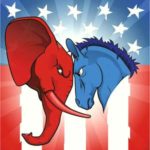
The U.S. is lagging in global competitiveness because its political system is so dysfunctional.
That’s the conclusion of the annual Harvard Business School study on competitiveness, which has found for the past five years that the United States is making virtually no progress to reclaim its elite position of decades ago in the global marketplace.
“We believe that the nation’s political system has now become America’s greatest competitive weakness, and that the situation continues to deteriorate,” the authors, three Harvard professors, wrote in the report titled “Problems Unsolved and a Nation Divided.”
“The problem now is frankly that we can’t make progress,” said co-author Michael Porter, who is widely considered the nation’s foremost expert on U.S. competitiveness.
The 102-page report places much of the blame on the presidential candidates – Democrat Hillary Clinton and Republican Donald Trump – and on a sharply divided Congress. USA Today offered this summary of the study’s key points:
Despite wide agreement among Democrats and Republicans on issues such as taxes and infrastructure, Congress remains deadlocked. On taxes, the parties “have wasted more than four years quibbling over a compromise number,” the study says.
The authors also favor more free trade, saying it will benefit the U.S., which has fewer barriers than other nations. Last year, a Pew Center poll showed most Republican voters supported free-trade agreements, but by March 2016, “divisive campaign rhetoric on the evils of trade had left 53% of registered Republican voters believing free trade was bad for America.”
Similarly, Democratic candidates’ anti-business sentiment has “set back” efforts to build consensus on economic policy.
“The Presidential candidates have too often appealed to Americans’ worst fears,” the study says.
Photo: sanders.senate.gov


Need more political parties, Environmental, Socialist, Liberal, Conservative, etc., etc. to stop the nonsense of “”choose 1 out of only 2 choices””. Politics is grey, overlapping, complicated, not exactly a simple “”this or that””.