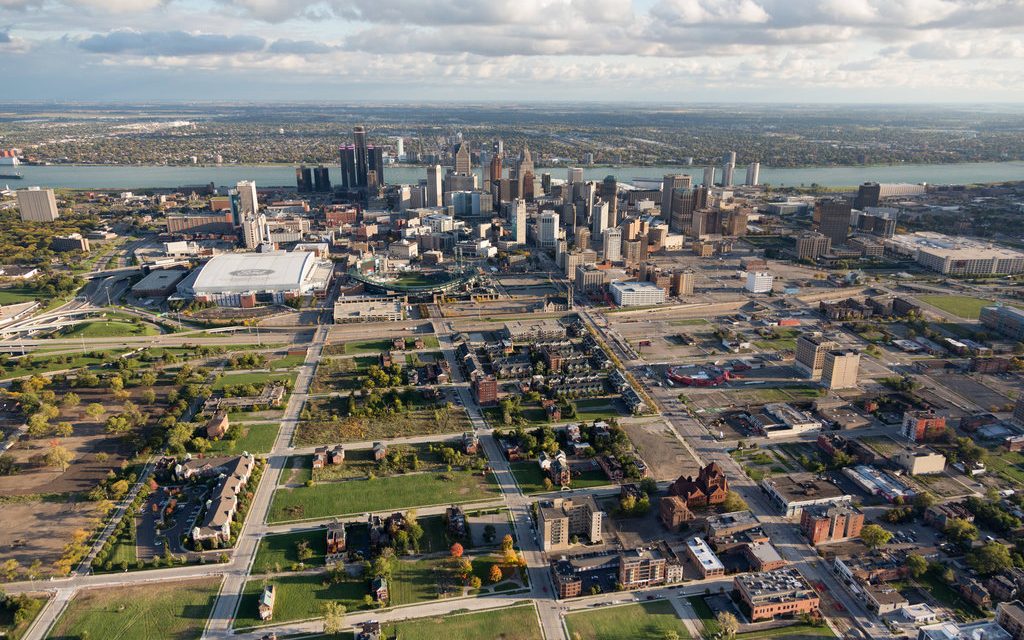
Top economists who specialize in urban revitalization have weighed in with a plan to spark the rebuilding of the many barren Detroit neighborhoods that ring the booming areas of downtown and Midtown.
In a report published by the National Bureau of Economic Research, economists at the Federal Reserve Bank of Richmond and Princeton University suggest a hands-on government approach in which the city would entice home builders to these areas by guaranteeing a minimum population in the future.
As reported by The Atlantic magazine’s CityLab website, the study notes that interest in reviving that ring of decrepit neighborhoods should be sparked by natural forces within the housing market. The land is extraordinarily cheap and the location is extremely close to workplaces, shops, restaurants and stadiums.
But the NBER report finds that no builder wants to take the first leap. That reference is to hard-hit neighborhoods such as Brush Park, Rosa Parks, Lower Woodward and Middle East Central.
From the study:
Most of these neighborhoods have been abandoned or demolished over the years, and in some of these areas, the city has stopped providing services. The main question that arises … is: Why do residential developers not move into these areas and develop residential communities where downtown workers can live? With residential areas close to downtown, workers would clearly save on commuting and downtown Detroit would benefit from more foot-traffick and demand for retail and other services.
The basis of our argument is simple and intuitive: residents do not want to be isolated in a neighborhood. They desire other residents with whom to socialize and who require the services they wish to consume.
The pre-condition for revitalizing a neighborhood is “that there’s a certain threshold of people,” Raymond Owens, co-author and economist at the Federal Reserve in Richmond, told CityLab.
What that means is the city would identify what the minimum amount of development is needed for each neighborhood – each Census tract — and then guarantee development of that size. The risks for private development would be minimized.
If they get the threshold right, according to Owens, developers would be stepping on top of each other to build homes, and momentum would take hold. Get the threshold right and the city would avoid putting any money up front, as future property tax revenues generated in the targeted area would skyrocket.
Get the threshold wrong, and the city is left buying up property that developers can’t sell, which would add to the tens of thousands of lots it already owns.
Yet, the authors of the study say that their calculations indicate that this approach would lead to higher population growth and housing price increases than the revitalization strategies put forth by Detroit Future City, a civic organization guiding the city’s revival.
According to CityLab, Owens and his colleagues tested the viability of their theory by creating a complex analytical model. They identified 52 vacant tracts, calculated the thresholds for each, and devised where the minimum guarantees would be most effective. They concluded that, if developed, these neighborhoods would attract home buyers from surrounding areas and outside the city.
Of course, this would be a gamble based on a wide array of market assumptions. So, before Detroit would embrace a wide-scale attempt to build from the inside out, perhaps a pilot project would be the first step to take.
Photo: National Bureau of Economic Research