 |
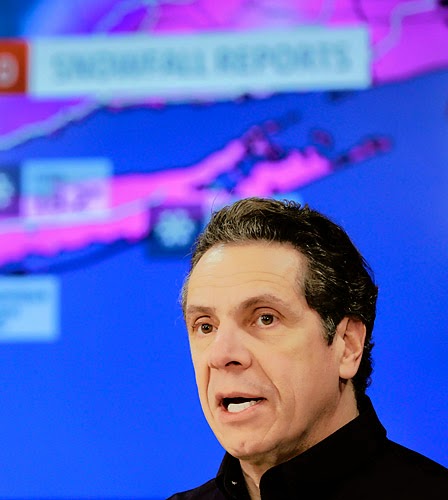
| N.Y. Gov. Andrew Cuomo tells reporters why the predicted blizzard never occurred. AP photo |
hooked up with weather forecasters who, by many accounts, have a bit of
huckster in them.
The “Snowmageddon” storm that was supposed to cripple New
York City this week serves as the latest example of governors and mayors
foolishly relying upon unreliable weathermen and women and their doomsayer proclamations to shape the government’s
response to the dark clouds approaching.
In New York City, as Winter Storm Juno (when did we start
naming blizzards?) neared, officials shut down the Big Apple’s 110-year-old
subway system for the first time ever due to snowfall. Travel bans blocked
traffic on highways in and out of the city. Airports closed, cancelling
thousands of flights. Commuter trains came to a halt. NYC’s 8.5 million people
were told by New York Gov. Andrew Cuomo and Mayor Bill de Blasio to hunker down
and prepare for at least two days of snowed-in isolation.
self-fulfilling prophecy.
But when the heart of the storm passed far to the east,
the forecasted snowfall of about two feet amounted to little more than eight
inches. And the pols had some explaining to do.
New Yorkers breathed a sigh of relief on Tuesday and then
collectively wondered, “What was that all about?”
What it was about is a reliance on a weather forecasting
business that too often gins up the numbers to get people’s attention. Much of
this is all about TV and radio ratings. Many of us in Michigan suspected as
much for years.
The National Weather Service’s computers had offered
three possibilities for NYC and neighboring New Jersey, where Gov. Chris
Christie also faced a lot of second-guessing questions on Tuesday after
shutting down highways and public transit. The three potential outcomes: one
foot, two foot, three foot.
The local and cable TV channels, including The Weather
Channel, latched onto the two foot narrative and let the story ride to its
conclusion. Some leaned toward the more intriguing story of a possible three
feet. The one-foot scenario was ignored.
to the public was exposed three years ago by Nate Silver, the statistician
whiz kid who gained fame in recent national election cycles by displaying an
uncanny ability to predict voting outcomes.
In his 2012
book, The Signal and the Noise,
Silver explained how weather reports in the media often fail to adhere strictly
to probability and statistics or sophisticated computer models.
For example, a study of
Kansas City stations found that local weathermen provided far less accurate forecasts
than the National Weather Service.
Some TV types blatantly adjust the numbers – snowfall,
rainfall, wind chills or heat – to get the attention of their audiences. The
Kansas City study found that when TV meteorologists warned to “get out your
umbrellas” due to a 100 percent chance of rain, it failed to rain at all
one-third of the time. This is what’s known in the business as the “wet bias.”
These forecasters speak with authority to their audiences
but, away from the cameras, they are unabashed in their thirst for TV ratings.
Incredulously, one of them said to the researchers conducting the study:
“Accuracy is not a big deal.”
of protector of the populace, relying on hucksters spouting phony forecasts in
order to take “bold steps” that they hope will be remembered by their constituency
at election time.
If the storm warnings prove faulty and the precautions
unnecessary, the pols do what they do best: They engage in finger-pointing.
They blame the weather forecasters.
The “better safe than sorry” approach stands as a far
more politically palatable path for these officials than failing to adequately
prepare and subsequently witness their constituents unexpectedly stranded in
the snow or dealing with power outages, suffering from hypothermia or, at a
minimum, cursing the mayor as they shiver in the cold.
Numerous officials have suffered at the hands of Mother
Nature in the past, including de Blasio during a botched snow-plowing effort by
the city during a blizzard last February.
The NYC mayor at that time not only engaged in
finger-pointing, he also took on the weathermen with another of the pols’ honed
skills: bickering. De Blasio engaged in a highly publicized battle with NBC
weatherman Al Roker over assertions that the meteorologists got things wrong.
unseemly love-hate relationship with their local meteorologists during last
year’s unprecedented winter.
Despite the record snowfall of 2013-14, several of the
largest storms predicted by the TV weather personalities never materialized.
School superintendents who took preemptive action by closing schools many hours
in advance of predicted precipitation were blasted by parents when only one or
two inches fell.
At the same time, if I recall correctly, one of the
largest storms to hit southeast Michigan went undetected by the weather
forecasting folks. Under those circumstances, it was the county officials and
road commissions that were blown away by the public outcry.
Again, better to brace for the worst possible scenario
than to get caught unprepared and suffer a devastating political setback. The politicians can rely upon the National
Weather Service, which offers far more accurate forecasts than the media, to
explain their level of precautionary measures. But their constituents listen to
the commercial outlets that live off of worst-case warnings.
of impending doom, people become fixated on their TV screens. TV producers take
full advantage. On-camera reporters shivering in a snowstorm become standard
fare for hours on live broadcasts, predicting possible death and mayhem as the
storm intensifies.
At the first sign of snowflakes, the bundled-up weather
reporters are out in the spotlight, demonstrating how they are braving the
blizzard – a storm that may never come to pass. If they’re wrong, they’ll move
on to another subject.
political stage, they sweat it out, hoping that the frigid cold and deep snow
comes as expected, offering them the comfort of a personal tragedy averted.