The rag-tag bunch protesting on Wall Street – and a whole lot of other American streets – still get failing grades on their political and PR skills, but they have two issues undeniably in their favor.
One is that it’s unassailable to say that the richest 1 percent have received all the economic benefits in recent American history. The other is that Wall Street fat cats play by good ol’ boy rules, not true economic standards.
USA Today recently ran an editorial that said:
““The (CEO) bonus system has gone beyond a means of rewarding talent and is now Wall Street’s primary business. Institutions take huge gambles because the short-term returns are a rationale for their rich payouts. But even when the consequences of their risky behavior come back to haunt them, they still pay huge bonuses.”
The irony here is that the latest egregious example of a failed CEO receiving a huge bonus is the case of Craig Dubow, who just resigned as the top executive at Gannett, the newspaper company that owns USA Today. Despite a string of failures, Dubow received a $37 million bonus as he walked out the door.
The irony here is that the latest egregious example of a failed CEO receiving a huge bonus is the case of Craig Dubow, who just resigned as the top executive at Gannett, the newspaper company that owns USA Today. Despite a string of failures, Dubow received a $37 million bonus as he walked out the door.
Dubow’s six years at Gannett were considered a disaster. On the day he took over, Gannett’s stock price hit $75; on the day he left, it was about $10. Dubow took the bean-counter approach to journalism, slashing the number of employees to 32,000 from about 52,000, resulting in an unavoidable decline in quality at the company’s 82 newspapers.
One Gannett journalist sent out an email message to colleagues saying Dubow’s royal treatment is enough to make anyone want to join the Wall Street protesters. “I’m pretty sure,” he wrote, “that none of the fired journalists (laid off by Gannett) received a $37 million retirement package. I’m not even sure if, collectively, all the journalists fired by Dubow’s company received $37 million.
One Gannett journalist sent out an email message to colleagues saying Dubow’s royal treatment is enough to make anyone want to join the Wall Street protesters. “I’m pretty sure,” he wrote, “that none of the fired journalists (laid off by Gannett) received a $37 million retirement package. I’m not even sure if, collectively, all the journalists fired by Dubow’s company received $37 million.
“… News like this makes you despair. Does Craig Dubow actually believe he’s worth $37 million?”
David Carr of The New York Times picks up the story: “Given that legacy, it was about time Dubow was shown the door, right? Not in the current world we live in. Not only did Dubow retire under his own power because of health reasons, he got a mash note from Marjorie Magner, a member of Gannett’s board, who said without irony that ‘Craig championed our consumers and their ever-changing needs for news and information.’
“But the board gave him far more than undeserved plaudits. Dubow walked out the door with just under $37.1 million in retirement, health and disability benefits. That comes on top of a combined $16 million in salary and bonuses in the last two years.
“But the board gave him far more than undeserved plaudits. Dubow walked out the door with just under $37.1 million in retirement, health and disability benefits. That comes on top of a combined $16 million in salary and bonuses in the last two years.
“And in case you thought they were paying up just to get rid of a certain way of doing business — slicing and dicing their way to quarterly profits — Dubow was replaced by Gracia Martore, the company’s president and chief operating officer. She was Dubow’s steady accomplice in working the cost side of the business, without finding much in the way of new revenue. She has already pocketed millions in bonuses and will now be in line for even more.
“Forget about occupying Wall Street; maybe it’s time to start occupying Main Street, a place Gannett has bled dry by offering less and less news while dumping and furloughing journalists in seemingly every quarter.
“Forget about occupying Wall Street; maybe it’s time to start occupying Main Street, a place Gannett has bled dry by offering less and less news while dumping and furloughing journalists in seemingly every quarter.
This is not “too big to fail;” this is a crony system with its own “too-connected-to-lose” process. Positive results and quality products matter little when it’s time to hand out bonuses.
A former Gannett reporter wrote this on his blog: “How did Dubow and Gannett serve the consumer? They laid off journalists. They cut the pay of those who remained, while demanding that they work longer hours. They closed news bureaus. They slashed newsroom budgets. As revenue fell, and stock prices tanked, and product quality deteriorated, they rewarded themselves with huge pay raises and bonuses.”
Those layoffs and pay cuts point the way to the other issue the Occupiers, the 99 percent, can call their own.
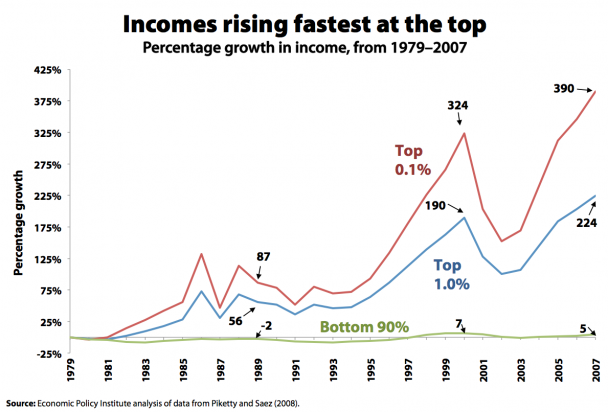
The Economic Policy Institute has come up with a fresh chart that reminds Americans about the huge income gains enjoyed by the top 1 percent, compared to the middle class and the working poor, going all the way back to 1979 – and before the Great Recession.
The Economic Policy Institute has come up with a fresh chart that reminds Americans about the huge income gains enjoyed by the top 1 percent, compared to the middle class and the working poor, going all the way back to 1979 – and before the Great Recession.
EPI found that, after adjusting for inflation, the top 1 percent saw their incomes jump by 224 percent from 1979 to 2007.
Those even better off, the top 0.1 percent (the top one one-thousandth of households), saw their incomes grow 390 percent. In contrast, incomes for the bottom 90 percent grew just 5 percent between 1979 and 2007. All of that income growth, however, occurred in the unusually strong growth period from 1997 to 2000, which was followed by a fall in income from 2000 to 2007.
Here’s the chart: