

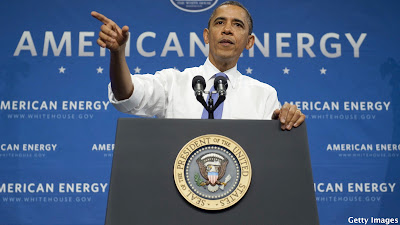

In his speech yesterday about energy policy, President Obama repeated popular lines from previous energy speeches, including the highly misleading claim that the increased fuel efficiency standards for vehicles will save the average family $8,000 by the middle of next decade.
Many motorists will quickly realize that the implication – an $8,000 a year savings at the pump — is ludicrous. Yet, many media outlets have misreported the facts by adding “per year” to their reports.
The CAFÉ standards that will take full effect in 13 years increases the mandated average miles per gallon for each automakers fleet to a whopping 55 mpg.
Sounds like a lot, but here is what the president does not explain to his audiences – administration estimates indicate that by 2025, the average family will save $8,200 in fuel savings over the life of a new vehicle compared to the amount spent on gas over the life of a vehicle bought in 2010.
That’s quite a bit different than $8,200 a year. In boasting about future savings, the president is guilty of misstating how much of an impact gas prices have on the average worker. In that sense, he sounds much like GOP lawmakers who blow out of proportion the impact of the current spike in gas prices.
For example: a 30-cent surge in prices, even if that price held steady for a year, would cost the average driver about $2.30 a week. This is the kind of number that never gets talked about. This is the reality that makes one realize that the periodic anger and fear expressed by motorists over gas prices is rather silly.
If you fast-forward to 2025 and adjust the figures for inflation, Obama’s new mpg requirement is certainly huge, but the savings are not quite at that level.
Let’s consider a couple in 2025 with two cars that each manage 55 mpg. They put 10,000 miles a year on each car. They pay the equivalent of $3.50 a gallon (adjusted for inflation, in this example, to 2012 dollars). Their annual fuel costs would be $1,274.
In 2012, that same couple, with all of their circumstances the same, except for owning cars that get 25 mpg overall, would pay $2,800 a year in fuel costs. That’s a savings of $1,526 a year, or nearly $30 a week split between the husband and wife. So, $15 for each.
Fifteen bucks is fifteen bucks, but it’s not going to change anyone’s lifestyle.
And there’s also a catch. A CAFÉ standard of 55 mpg will require expensive technology that’s now available in only a few high-end vehicles, according to Edmunds.com, a website that closely follows the auto industry.
For that technology to be put into all cars and trucks, Edmunds.com estimates that sticker prices would rise by a range of $1,000 to $9,300 per vehicle. Two federal agencies put the price tag closer to $1,400 to $2,600 per auto purchase.
We’ll have to wait 13 years to find out who is right. Either way, that’s an awfully big offset to the savings at the pump that Obama boasts about.


I am guessing that the focus of the government is on reducing emissions and not savings for the average family.