
New York City Mayor Bill de Blasio won election in 2013
by advocating a number of new programs to help the poor in a city that may
serve as the global center of income inequality.
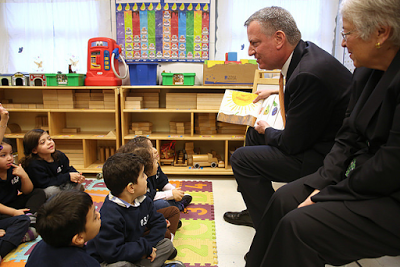
A key initiative by de Blasio was universal
pre-kindergarten classes but a report published by ProPublica found that in the
second year of the program the 12,000 registrations included just 195 kids from
the city’s 20 poorest ZIP codes.
That is an increase of just under 1 percent for families
that make less than $38,000 a year. All other income groups saw large
percentage increases from 27 percent to 43 percent.
While it’s safe to assume that New York City’s many
millionaires send their kids to private schools, it’s also likely that many of
the families benefiting from free pre-K earn incomes well into the six-figure
range.
extended well beyond targeting the poor to broad eligibility requirements
designed to give a program maximum popularity.
Liberal Democrats in Congress took this same approach in
2009 when they expanded the health care program known as SCHIP to middle class
families. In New York City, a family earning $85,000 qualifies for SCHIP, which
provides them with free health care for their (under age 19) kids. At the same
time, the Medicaid program in Mississippi does not cover adults and its health
care eligibility in 2011 was limited to kids from families earning $8,136 or less.
That’s the equivalent of $156 a week.
more disturbing when the subject is pre-K. That’s because, while most of the
NYC resources are going to non-poor families, research shows that the
advantages of pre-K are minimal for kids who grow up in average-and-above
families.
Here’s how ProPublica explains it:
everybody else is important because decades of academic research have shown
that children from low-income families who attend pre-K benefit immensely, but
those benefits decrease as you move up the income ladder and may even disappear
beyond the middle class. The universal pre-K program was a hallmark of de
Blasio’s campaign to make free pre-K education a right for every New Yorker and
to narrow achievement gaps, which start very early in child development.
disparities in children’s learning until he focuses more directly on poor
communities, lifting low-income families,’ said Bruce Fuller, a UC Berkeley
professor who has analyzed the city’s universal pre-K program and provided
ProPublica with his analysis of the newest numbers.”