 |
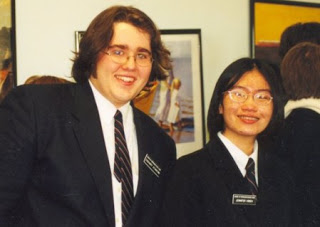
| A shaggy-haired Zack Stanton during his days as a congressional page, before becoming a political consultant. |
This was not just another congressional scandal.
It instantly brought down the perpetrator, Republican Congressman
Mark Foley of Florida, in September 2006 and within weeks precipitated the
abrupt resignation of House Speaker Dennis Hastert. The perceived cover-up by
the House GOP leadership of Foley’s sexual preying upon young, male
congressional pages emerged as a major factor in the Democrats taking control of
Congress that November and making Nancy Pelosi the first female Speaker of the
House.
who made this all happen was Zack Stanton, who got his professional start in
Macomb County and Michigan politics. He revealed that, five years after he served
as a teen congressional page at the Capitol in 2001, he was the person who
leaked the details of Foley’s longtime, lurid sexual flirtations with page
boys.
In a piece written for Politico Magazine published on
Friday, Stanton explains that he clandestinely provided ABC News with
transcripts that detailed Foley’s behavior years earlier and established an
elaborate pattern of perversion. Former pages knew that Foley’s crude
flirtations were far worse than what had been reported at the time but they
were afraid to talk.
One hour later, a resignation
Foley staffer with the new information they had obtained. Just one hour later,
the aide called back and said that Foley was going to step down. An hour or so
after that, it blew up on the national news. Stanton recalls thinking: “What
the hell had I gotten myself into?”
 |
| Foley |
In sterling prose, Stanton writes about the wonderment,
excitement, fear and paranoia that enveloped him over the following weeks and months.
(He had first experienced emotional overload in just his second week as a page,
on 9/11, when he frantically sprinted into the streets of Washington as word
spread that a terrorist-commandeered airliner was headed for the Capitol.)
As the investigation of the Foley scandal unfolded, and certain pages from the
past were suspected of leaking the AOL Instant Messenger comments that were
Foley’s downfall, Stanton was interviewed by the FBI while a student at Michigan
State University. A few months later he was questioned by House Ethics
Committee investigators.
The implications were overwhelming for a young man: Before
his departure, Hastert had requested a sweeping probe to pinpoint “persons who
knew or had possession of these messages but did not report them.”
Hastert bears his own scandal
It was Hastert’s own scandal all these years later –
secretly paying millions of dollars to hush up an alleged sexual dalliance with
a high school boy long ago – that prompted Stanton to go public with his story
at this time. He’s now convinced that the soft-spoken, grandfatherly Hastert,
an Illinois Republican, was at the center of the cover-up of Foley’s sleaziness
for several years.
 |
| Hastert |
Stanton has bowed out of the political scene, working
instead for the Wilson Center, a think tank that specializes in global policy
issues, located practically down the street from the Capitol that was a big
part of his life as a teen and a decade later as a speechwriter for Congressman
Sandy Levin and other key lawmakers during the Democrats’ majority status.
The son of Tom Stanton of New Baltimore, a longtime writer
and newspaper reporter, Zack Stanton initially put the disturbing page scandal
behind him and in 2002 worked as a staffer on former congressman Dave Bonior’s
gubernatorial campaign – making Stanton one of “the Bonior Boys” – and later as
an operative for the Macomb County Democratic Party.
He spent several years happily toiling as a political
consultant before returning to Capitol Hill to work for the House Ways and
Means Committee when Levin, a Royal Oak Democrat, served as chairman of the
powerful panel.
Two overwhelming regrets
about his role as informant.
The name of the fellow page who was Foley’s prime object
of desire slipped out during the media frenzy of 2006, damaging the man’s reputation.
And the page program, a Capitol Hill tradition more than two centuries old, was
disbanded by the House a few years later.
“It’s
a sad reality that Congress chose to eliminate the program, and speaks volumes
— it was the actions of the congressmen that merited reform and condemnation,
not the actions of pages,” he notes. “If Congress can’t seem to trust itself
around teenagers, getting rid of them is simply blaming the victims rather than
stopping the perpetrators.”
 |
| Stanton |
Stanton describes his desire to move beyond politics, which served as his
“secular religion” in younger days. But I wonder: If he had not been thrust
into the ugly side of congressional self-righteousness as a teen, would he have
remained working within the “hallowed halls of Congress” that first grabbed his
undivided attention as a civic-minded eighth grader?
“Nowadays when I visit the Capitol,” he
concludes, “I get the feeling people do when they walk the halls of (their) old
high school. Every sight triggers a memory. Here’s the place where Barney Frank
would sit and read the newspaper while chewing on a cigar. Here’s where Jim
Traficant gave me a fist bump. Here’s the stairway I ran down when I thought a
plane was about to crash into the building.
“As a page, I’d wander the empty hallways and feel the
ghosts of history swirl around me; now, it’s much the same, except I am one of
those ghosts, and the history is personal. The Capitol, in that sense, is
haunted.”
Recent Posts:
 Obamacare in a ‘death spiral?’ GOP and Berniecrats…
- Michigan companies can’t fill jobs because too…
- Warren ranked the most ‘white trash’ city in Michigan
- Michigan avoids being Foxconned – Snyder bailed out…
- The recession recovery: Michigan No. 1 while 35…
- Islamophobic SH candidate calls on Michigan Tea…
- Michigan counties face a heavy hurt under…
- Michigan Obamacare rate increases could average 28 percent