On the
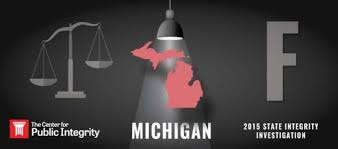
heels of a November report that found Michigan ranks last in the nation in
anti-corruption laws that force openness and transparency in government and
elections, the state Senate seeks to bury Michigan further into the last-place
category by allowing more “dark money” to dominate campaigns.
today, the Senate voted to create superPACs at the state level that can collect
unlimited millions of dollars from corporations and unions and then spend the
money to benefit campaigns for state offices without disclosing the individual donors
of those funds.
move toward increased dominance of dark money flies in the face of a report by
the watchdog group Center for Public Integrity that found Michigan sits at the
bottom of the 50 states in its overall good-government rankings, including in
the category of campaign financing.

Common
Cause, another group that keeps watch on shady government actions, blasted the
Senate vote as a shameless step backward.
accountable and transparent, politicians in the State Senate are ramming
through legislation that will pump more secret, unlimited dark money into our system,”
said Melanie McElroy, executive director of Common Cause Michigan.
“We all know that the influence of secret money has
a corrupting effect on elected officials. These bills should be rejected
now or vetoed by the governor and new ones introduced that get dark money out
of politics altogether.”
language into the Michigan Campaign Finance Act that explicitly allows for
superPACs at the state level. The legislation feeds on the widespread creation
of superPACs at the federal level that followed the controversial 2010 U.S.
Supreme Court ruling in the Citizens United case that allowed for unlimited
corporate and labor campaign funding.
Michigan, said the bill was a long time coming for superPAC supporters. If
approved next by the House and signed into law by the governor, Robinson said,
Michigan election campaigns would be marked by “bank-shot bribery,” with
big-money interests able to unduly influence elected officials by indirectly
pouring funds into campaign advertising.

“The
disturbing aspect, in my mind, is the writing into law of ‘bank-shot bribery,’”
said Robinson, director and founder of the Michigan Campaign Finance Network. “If
a candidate can raise money for a superPAC dedicated to supporting that
candidate, we have effectively eliminated contribution limits and restrictions
against corporate contributions to candidates, which are meant to inoculate
against corruption.”
author of the bill is Sen. Dave Robertson, the Grand Blanc Township Republican
who chairs the Senate Elections Committee. Robertson is a leading force in the GOP’s
efforts to push through a series of partisan election law changes before the
start of the 2016 election year. Those measures include the elimination of
straight-ticket voting and restrictions on local clerks’ ability to assist with
absentee voting.
In this morning’s Senate debate, Robertson suggested that
increasing the amount of dark money in Michigan campaigns is merely an attempt
to update Michigan law to match the no-holds-barred atmosphere at the federal level
generated by the Supreme Court.
of this issue… it makes sense to codify the high court’s decision in state
statute,” he said.
Pirich, said the Senate bill is “a lawyer’s dream” because it would make
the playing field in state elections abundantly clear, declaring that
everything allowed at the federal level would be fair game at the state level.
several months of research, concluded that Michigan lacks rules related to accountability
and ethics because it relies upon “an honor system with no honor.”

One longtime player on the political scene, former state
Democratic Party chairman Mark Brewer, said that Michigan’s election process
has become “the Wild West … with no sheriff in town.”
While Common Cause played no role in the Center for
Public Integrity study, McElroy expressed dismay that lawmakers would react in
such a counterproductive manner.
“Instead of seeing this report and moving to enact laws
to make our government more open and accountable, the leaders in the Senate
have decided to double down on corruption and unaccountable dark money,” she
said.
damning report is further proof that some in our state government are more
concerned about large donors than they are about the people they are elected to
represent.”