


Three years after Gov. Rick Snyder made a road-funding
fix his top priority — and many months after numerous bumbling, failed
attempts in the Legislature to address Michigan’s crumbling highways and bridges
— it appears that our feckless lawmakers have lost touch with reality.
Last week, the House passed a road funding plan that generated
applause and pride from disconnected legislators, even as it failed to address
the problem on any front.
Worse yet, the Lansing press corps treated this newest
development as a battle of tactics, a political spat between the House and
Senate (both controlled by Republicans), a strategic push for a House-Senate
conference committee, and an intriguing intra-party feud that puts Gov. Rick
Snyder on the spot.
problems of potholes and dangerous bridges in such a way that it offers funding
far short of a solution, and new revenues that don’t fully kick in until 2021.
From the standpoint of our timid lawmakers, the House GOP proposal,
slammed together in a matter of hours last Thursday night, allows them to dodge
blame for road tax hikes, as they will all be term-limited from office long
before this fetid plan takes full effect. Meanwhile, the condition of Michigan
roads and bridges – with economic vitality and motorist safety both at issue –
declines every day, and especially every winter.
this grotesquely obvious crisis, I offer several observations with the help of former
state treasurer Robert Kleine and the nonpartisan Citizens Research Council of
Michigan:
The problem: After
two decades of neglect, Michigan’s transportation system needs, at a minimum, a
$1.2 billion annual infusion to repair and modernize countless, roads, highways and
bridges. But the House approach to a catch-up plan, clearly lacking any
urgency, initially offers just $400 million (mostly in the Spring and Summer of
2017) and does not reach the $1.2 billion level for six years – at a time when
that price tag likely will be out of date.
After all, we all know that the Great Lakes State probably
suffers from the least road-friendly weather in the nation, with wild swings
between rain, sleet and snow, including chronic dampness and frost throughout
the early Spring.
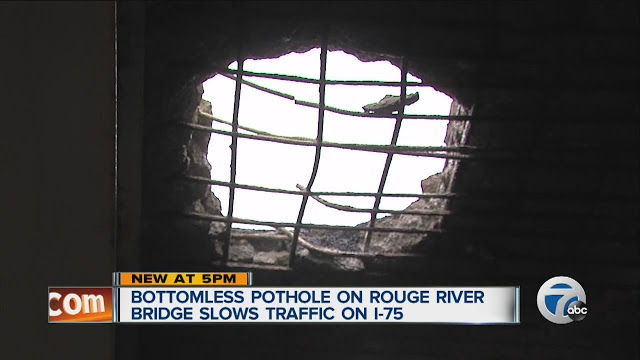
occurred on Monday at the River Rouge bridge on I-75 in Wayne County, the
latest in a series of crumbling pavement incidents on heavily traveled freeway
bridges.
The hole on the bridge, which measured 6 feet by 6 feet,
created a crater in the center right lane of northbound I-75. The ensuing
rush-hour traffic jam afforded few available alternative routes, as bridges
across the river at Fort and Jefferson streets remain closed.
the House plan and get real.
The problem: Conservative lawmakers and their
constituents remain engrossed in some kind of La-La Land where they’re
convinced that Michigan is a high-tax state.
In contrast, the data shows that this tea party perception is way off
the mark.
According to the Tax Foundation, Michigan’s overall tax
burden ranks 21st on the list of 50 states. Looking at the data in a different
way, based on taxpayer-friendly figures, our corporate taxes rank 10th best, the
state income tax is 12th and the state’s “Business Tax Climate Index” is 13th.
Another measurement shows that the state-local tax burden
in Michigan is 33rd highest in the nation — lowest among the Great Lakes
states and below the national average.
Michigan can’t afford not to substantially raise its gas tax to make up for two
decades of inaction. With routinely wild swings in gas prices at the pump over
a 24- or 48-hour period, would Michigan motorists revolt if a gas tax of 20
cents per gallon was phased in over several months? Is an end to crumbling and
congested roads worth a price of about $1 a week for the average motorist?
The problem: Twenty cents per gallon? Many taxpayers,
without evidence of historical facts, would consider that outrageous. Too many
of these motorists fail to realize that the outdated, 19-cents-per-gallon gas
tax is a stagnant fee, regardless of current gas prices, not a percentage that
rises as pump prices increase.
In reality, experts say that revenues from fuel taxes
at the pump have declined dramatically over the past two decades for
two reasons: Basic cost-of-living increases and a variety of road construction costs that have
exceeded those basic inflationary figures. The result has been headaches for state and
local road departments across the nation.
Based on the funding formula, the Michigan gas tax, last
raised in 1997 during the Engler administration, would have to at least double
to (nearly) keep pace with ‘97 revenues. In
addition, the diesel tax on commercial trucks should gain parity with the levy
on passenger cars and pickup trucks.
for the road funding problem. While imperfect as a “user fee” to finance modern
transportation, only the gas tax ensures that out-of-state truckers and drivers
will pay a share of the road-improvement price tag.
The Problem: House
members assume that Michigan can better compete with other states for jobs if
we shrink government and devote more General Fund budget money to
infrastructure.
In fact, setting aside federal money that filters down
from Washington, Michigan spending derived from state taxes and fees has
declined more than 6 percent since 2000, adjusted for inflation. According to
another measure focused entirely on unrestricted funds that the Legislature fully
controls, those monies have declined, on an inflation-adjusted basis, by 23
percent in roughly that same time period.
So, the evidence indicates that Michigan is neither a
high-tax nor a high-spending state. Meanwhile, the safety net for the working
poor, and the temporarily poor, is shredding.
The Solution: The plan to shift spending priorities should be abandoned.
during a seemingly endless series of budget reductions, no state has cut
spending more than Michigan. For example, the number of state government employees
sits at its lowest level in 40 years, since the mid-1970s, despite a subsequent
big expansion of the prison system.
The Problem: While Michigan’s unemployment rate has
plummeted under Gov. Rick Snyder, the level of depressed wages and household
incomes remains troubling. The poverty rate across the state, especially in
northern Michigan, has barely budged since the Great Recession of 2008-10. Child
poverty is stuck at nearly one in four kids.
But a road plan to cut of $400 million (under the House plan) or $600
million (under a dormant Senate plan) from the General Fund would inevitably
hit the working poor and lower middle class the hardest.
By largely
side-stepping gas taxes on those who use the roads the most, by siphoning $400 million or $600
million from the GF, the Legislature would put Michigan behind just four other
states in disconnecting road funding from those who rarely use the roads – whether senior citizens
or the poor.
In 2000, prior to the “Lost Decade” under Granholm, Michigan’s
per-capita income ranked 18th best among the states. By 2013, per-capita income
dove to 35th.
With our long-term, dramatic loss in good-paying, blue-collar
jobs, despite the stunning revival of the domestic auto industry, a state
budget that has already endured countless cuts should not serve as the whipping
boy in a desperate attempt to get our roads back into shape.
Kleine argues that we have little to show
for all the individual and business tax cuts handed out by the Snyder
administration and the GOP-dominated Legislature, except for poor roads, higher
college tuitions (sixth highest in the nation), struggling local governments
and school districts, and below average incomes.
That assessment, by a former state treasurer who served
in a Democratic administration derisively viewed by Republicans everywhere, could
be dismissed by far-right lawmakers and constituents.
the wane, Michigan’s hyper-partisan leaders can only ignore history and reality
for so long, at our great state’s own peril.

Look – Corporate Michigan instituted a just in time shipping procedure across the board increasing truck traffic ten fold and saving millions of dollars in not paying taxes on inventory. None of these proposals even mention corporate Michigan as a contributor to the road fix. Although they will in fact benefit most from the roads being fixed.