For those who fall into the category of “can’t the federal government do anything right?” here are the latest figures indicating improper overpayments by Washington to the populace.
According to the fed’s latest estimates, government programs for fiscal year 2015 paid out $137 billion “improperly” — meaning that these payments violated guidelines or rules in some way. Fraud is not the only reason, as the federal government reports, and these numbers certainly do not include improper payments by the Defense Department and other agencies to contractors.
Instead, in this context, an improper payment can result from simple clerical error or failure to confirm that a recipient was eligible to receive the amount of money that was disbursed.
In other words, various screw-ups at the federal level.
As noted by the right-leaning Mercatus Center at George Mason University, whether due to fraud, the complexity of program rules, or bureaucracy, $137 billion is a significant amount of taxpayer funds.
The total amount is just a tiny portion of the overall federal budget, but it does raise questions about oversight of the numerous federal departments and agencies.
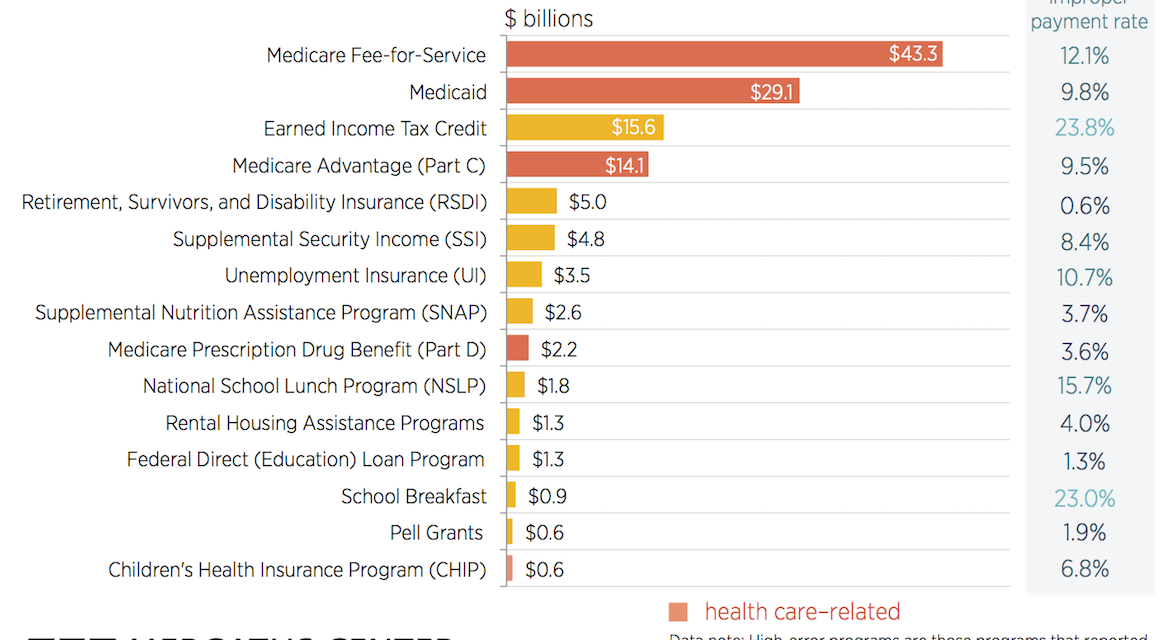
The chart above presents improper payments made by the 13 programs that the Office of Management and Budget has criticized for “high error” rates.
According to the Mercatus Center, the chart ranks faulty transfer programs that allocate at least $750 million in payments annually. The chart also displays the total improper payment rates as a percentage of total spending for each program.
Mercatus asserts that the Earned Income Tax Credit (EITC) for the working poor has a high improper payment amount and a relatively high improper payment rate. The $15.6 billion in improper EITC payments represents a substantial portion, 24 percent, of total EITC spending — suggesting that the EITC is particularly prone to waste, fraud, and abuse.
As the chart indicates, the National School Lunch and School Breakfast programs, Medicare Fee-for-Service, Medicare Advantage (Medicare Part C), and Unemployment Insurance apparently face problems similar to the EITC.
Congressional Democrats insist that questions about the EITC’s effectiveness are exaggerated.
As for Medicare, the reform program created and championed by congressional Republicans, Medicare Advantage, now faces sharp criticism from federal auditors.
Beyond the taxpayer dollars involved, in Michigan, mismanagement of the Unemployment Insurance program has emerged front and center in recent days.
Again, the partisan arguments back and forth can be made in terms of real dollars or in terms of percentages.
Programs such as Social Security Retirement, Survivors, and Disability Insurance (RSDI) program, have improper payment amounts that are relatively high when compared to their improper payment rates, according to Mercatus. While $5 billion was improperly spent on Social Security benefit payments in 2015, the large overall amount of benefit payments made by the agency ($863 billion in 2015) means that the improper payment rate is only 0.6 percent.
Here’s the Mercatus view on excessive payments:
It is worth noting that the federal government’s figures are only estimates, and there is reason to believe the government intentionally underestimates the amount of taxpayer dollars lost to fraud and bureaucratic ineffectiveness. For example, three of the largest programs in terms of improper spending amounts are all related to health care. Medicare Fee-for-Service, Medicare Advantage (Medicare Part C), and Medicaid combined for $86.5 billion in improper payments in fiscal year 2015.
However, Malcolm Sparrow of Harvard University, a recognized expert in health care fraud, argues that federal auditors underestimate the volume of improper payments in (the health care field). He believes fraud could account for as much as 20 percent of federal health spending, which would considerably increase the improper payment figure reported by the government.
… While people of good conscience on both sides of the political aisle can debate the merits of whether or not government should be involved in certain activities, policymakers should agree not to tolerate the high levels of improper payments currently associated with government spending on social welfare programs.