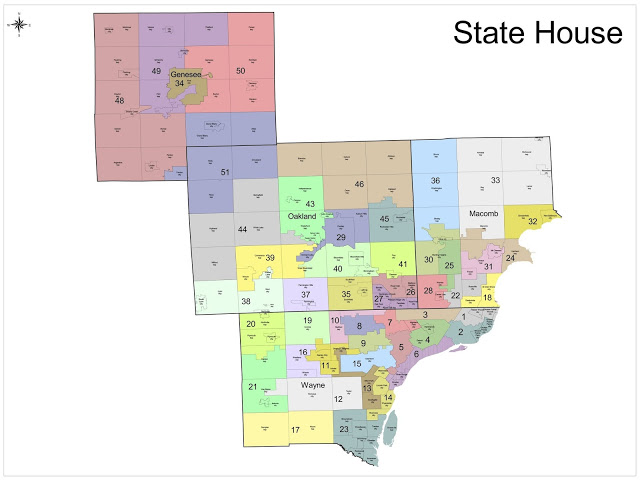

The latest analysis of Michigan’s gerrymandered state
House districts shows that the 2016 elections offer so little competition that
most of the races could be called right now.
The quality of the candidates, campaign tactics,
fundraising efforts – none of that means much when the district lines are drawn
in such a partisan manner that the outcome is nearly certain, in favor of one
party or the other.
House districts are “toss-ups,” and of those, just two are located in the
Detroit tri-county area. Due to the 2011 redistricting process, the population
center of Michigan likely will experience competition-free House elections next year, with a couple of
exceptions –the 30th District occupied by term-limited GOP Rep. Jeff
Farrington, who represents Utica and portions of Sterling Heights and Shelby Township, and the 23rd District, represented by another
term-limited lawmaker, Republican Pat Somerville, whose constituency includes much of the Downriver area.
51-47 edge for the Republicans. That total includes 18 Republican-leaning
districts and one Democrat-leaning district.
Susan Demas, IMP editor and publisher, calculates that
the base vote is so skewed by the zig-zagging district lines that the remaining
79 seats are solidly in the column of one party or the other.
already sees the push for a redistricting reform ballot proposal in 2016
faltering.
The League of Women
Voters continues its series of 35 town hall meetings across the state to
discuss the benefits of putting redistricting in the hands of an independent
commission, as several states already do. But LWV leaders told Gongwer News Service that they haven’t been able to generate the finances necessary to
launch a petition drive.
“Nobody has been
willing to grab the ball, lead this campaign, and put a name and money behind
it,” Lessenberry said in his radio commentary earlier this week.
is a touchy subject with partisans on both sides, who greet talk of reform
with cynicism and suspicions of a power grab by the opposing party. Even a
staunchly nonpartisan group like the LWV has suffered skepticism of their
motives voiced by crass conservatives.
The LWV should continue to play the lead role but perhaps
what’s needed is the emergence of two political commanders who are widely respected within their respective camps — one Republican,
one Democrat — much like George H.W. Bush and Bill Clinton teamed up in recent
years on certain projects.
leaders of considerable stature and political connections. Maybe former
Michigan senators Carl Levin and Spence Abraham (who also served as state GOP
chairman) would fit the bill.
As Lessenberry pointed out, failure should not be an
option for a reform movement of such gravity.
studied the issue and has any sense of fairness,” he said, “knows that our
present system of gerrymandering has badly crippled democracy in this state.”