Taking advantage of the momentum established by federal court rulings, Democrats are preparing to challenge the “gerrymandered” legislative districts across Michigan.
A lawsuit in the works by attorney Mark Brewer will ask the U.S. District Court to strike down the boundary lines drawn by Michigan Republicans for seats in Congress, the state House and state Senate.
“In 2011, the Republican-controlled Legislature intentionally and effectively gerrymandered the maps to benefit Republican state and federal legislators and diminish the effect of the votes of Democratic voter,” Brewer, former Democratic Party chair for Michigan and Macomb County, said in a letter to potential witnesses giving notice of the lawsuit.
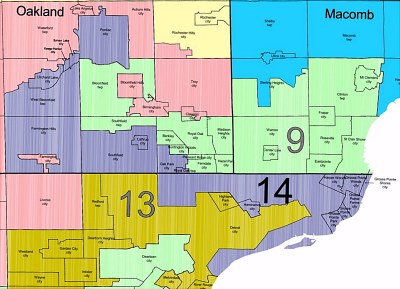
Election reformers say voting results since the redistricting process of 2011 reflect the very definition of gerrymandering as the party in power kept its majority despite receiving fewer votes. The squiggly lines carved out by the GOP, based on 2010 Census numbers, essentially allowed Republican incumbent officeholders to choose their territory and preserve their seats.
The partisan advantage of the current maps is apparent. In 2012, Michigan Democrats received 52% of the votes cast for state House, but won 46% of the seats. In 2014, Democratic candidates received 51% of the votes for state House, and won 43% of the seats. In 2016, Democrats received just under 50% of the votes for state House, and again won 43% of the seats. And in congressional races in 2016, Democrats received 47% of the votes, but won just 36% of the seats.
Of course, Democrats similarly drew the districts to their advantage when they controlled the Legislature in the 1960s and 1970s.
Activists nationwide targeting the old-school gerrymandering process have scored court victories over the past two years in Virginia, North Carolina, Arizona, Texas and Alabama. But the newest federal court ruling in Wisconsin set a precedent by striking down districts based solely on partisan gamesmanship rather than violations of equal protection for minority voters.
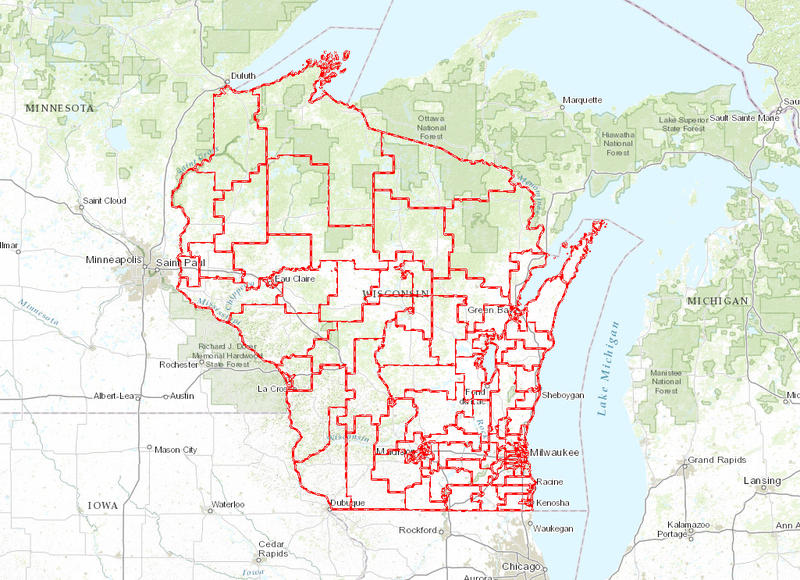 On Friday, a federal court ordered Wisconsin officials to redraw the state’s lines (see map at right), an edict that followed a ruling rejecting the districts in November. The ruling is expected to be appealed to the Supreme Court.
The partisanship on display in Wisconsin is especially blatant as Democrats captured 200,000 more votes for the Assembly (state House) in the 2012 election but Republicans won 60 seats, compared to 39 for the Dems.
“We think we have good evidence of partisan gerrymandering in Michigan that meets the standard set by the court in Wisconsin,” Brewer told the Detroit Free Press.
“There is evidence the Republicans did it intentionally.”
Last year, an extensive campaign by the League of Women Voters to put a redistricting reform proposal on a statewide ballot failed. The plan called for a nonpartisan panel to draw district lines, not partisan politicians.
The LWV pointed out that, over time, both political parties have played the gerrymandering game to create “safe” seats for their members. The result is this – noncompetitive November general elections across the state have little impact, to the point that most incumbents from each party seeking re-election need only survive the low-turnout August primary to maintain their job.
Recent Posts:
 Anti-gerrymandering plan is complete overhaul of…
- Dems in disarray – more than two dozen candidates in 2020?
- Michigan companies can’t fill jobs because too…
- Warren ranked the most ‘white trash’ city in Michigan
- Michigan avoids being Foxconned – Snyder bailed out…
- The recession recovery: Michigan No. 1 while 35…
- Islamophobic SH candidate calls on Michigan Tea…
- Michigan counties face a heavy hurt under…