

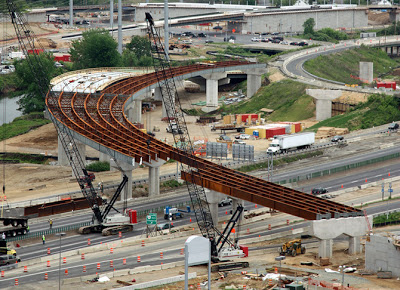
In two weeks, if the House does not act, Congress will be forced to adopt its ninth stop-gap measure (essentially a short-term continuation budget) in the past three years because no one on Capitol Hill can reach agreement.

When an impasse was broken earlier this week and 72 senators unified to pass the Boxer-Inhofe transportation bill, the situation looked bright. But Politico is reporting that the House won’t take up the Senate bill before the end of the month, which means not before the deadline expires. Which means a ninth stop-gap. Which means another period of months in which states have no stable, predictable blueprint from Washington that would allow for long-term repairs to crumbling infrastructure.
Beyond the lack of trust between the states and the Capitol, missing the March 31 deadline would mean federal funds drying up and tens of thousands of construction workers losing their jobs, at least temporarily.
Ezra Klein at the Washington Post has mounted an admirable effort to shame the Congress into passing a highway bill. Klein notes that highway bills have traditionally been one area where bipartisan cooperation on Capitol Hill was almost certain.
Here’s a part of what he wrote yesterday:
“The recent history of this issue is not inspiring. Surface transportation bills used to be easy to pass. As Sen. Dick Durbin said, they were ‘the easiest bill to pass.’ After all, every member of Congress has a pothole in his district, or a bridge that needs some repairs.
“In recent years, however, the easiest bill has become a lot more difficult to pass. The last long-term highway bill was signed in 2005. It expired in 2009.”
If the House comes through, a funding failure would be avoided and the Senate would have succeeded in killing a prior House bill that attempted to tack on unrelated measures dealing with oil exploration. Transportation Secretary Ray LaHood — a former Republican congressman from Illinois — called it “‘the worst transportation bill I’ve ever seen.” It failed to win support in the House.
Yet, Klein reports today that the Senate bill is nothing to celebrate. The $109 billion total is one-third less than President Obama wants and far less than some transportation groups say the nation needs. The bill also lasts just two years rather than the more typical five-year timeframe, which is what the White House wants. And it doesn’t deal with a Highway Trust Fund that is running dry.
Many motorists would be surprised to learn that the trust fund, which is financed by federal gas taxes, has become far too small to meet the needs. People are driving less, they’re buying fuel-efficient cars, and the per-gallon tax at the pump hasn’t changed in many years.
Klein sums things up this way:
“This is a bad time to do a half-measure on infrastructure. We have literally trillions of dollars in unmet infrastructure needs. We have massive unemployment in the construction sector. Materials are unusually cheap because of a depressed global economy. Borrowing is unusually cheap because we’re one of the few safe havens left in the global financial market. And it’s cheaper to repair an aging bridge today than rebuild a crumbled one 10 years from now. So waiting to do the bulk of our infrastructure — passing a half-measure on infrastructure investment later — is like waiting till after the big sale ends to buy your groceries. It’s just bad financial planning.
“… (The Senate bill) is a lot better than doing nothing. It’s a lot better than another stopgap. And Sens. Barbara Boxer and James Inhofe deserve credit for actually moving a bipartisan infrastructure bill through the Senate. But it’s a reminder that, these days, even when Congress does get around to doing its job, it doesn’t do it particularly well.”
You can read more here.


True, but at least we've taken steps to reduce the incidents of protected sex or birth control on the pot-holed highways we have left.